
Patient Condition and History
Lucas is a 10-year-old neutered male Beagle diagnosed with Chronic Valvular Heart Disease (CVHD). He has been receiving long-term treatment with Benazepril and is monitored continuously with the PetPace smart collar, which tracks multiple physiological parameters to support remote clinical assessment.
Over several weeks Lucas’ clinical status worsened. His owner, Michelle Saltzman of Bedford, MA, brought him to Chelmsford Animal Hospital where Dr. Patricia Berchtold evaluated him and diagnosed congestive heart failure (CHF) secondary to CVHD. Treatment began with a diuretic, furosemide, to address fluid accumulation and relieve symptoms. When additional support was needed, Vetmedin® (pimobendan) was added to the regimen. Following these interventions Lucas showed marked clinical improvement, corroborated by data recorded by the PetPace collar.
Monitoring Data
Continuous physiologic monitoring captured by the PetPace collar revealed gradual, measurable changes in the weeks before Lucas’ congestive heart failure was clinically recognized. Two of the earliest and clearest signals were incremental increases in Lucas’ minimum pulse rate and minimum respiratory rate. These trends unfolded over multiple weeks and were visible in the collar’s time-series data.
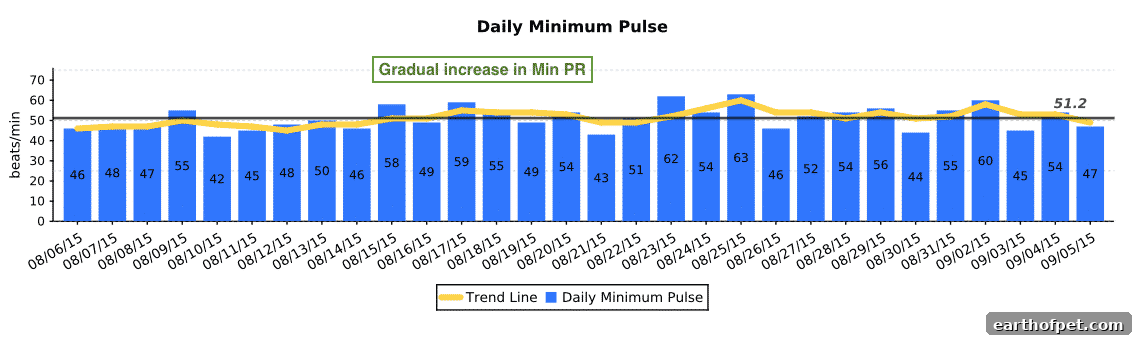
* MINIMUM PULSE RATE GRADUALLY INCREASING (YELLOW TREND LINE) OVER 1 MONTH PRIOR TO HEART FAILURE.
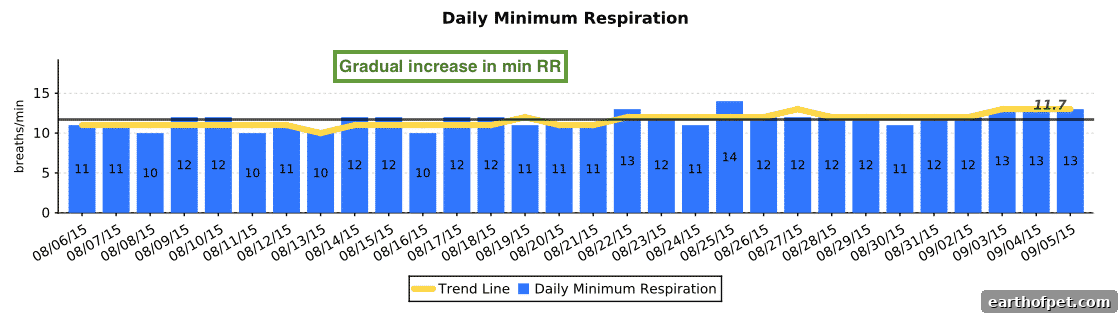
* MINIMUM RESPIRATORY RATE GRADUALLY INCREASING (YELLOW TREND LINE) OVER 1 MONTH PRIOR TO HEART FAILURE.
Heart rate variability (HRV), a validated marker of autonomic and cardiac health, showed a clear decline over the same interval. In Lucas’ case the triangular index—one HRV measure—fell by approximately 15% in the weeks preceding the CHF episode, highlighting worsening cardiac function before severe symptoms appeared.
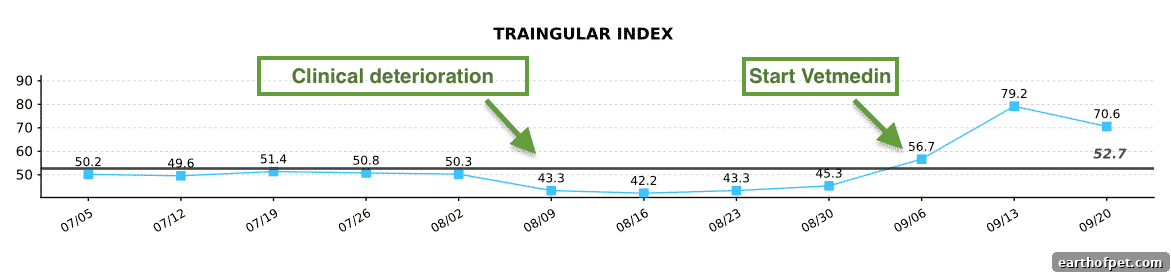
* TRIANGULAR INDEX, AN EXAMPLE OF HRV, SHOWING APPROXIMATELY 15% DECREASE IN THE WEEKS PRECEDING CONGESTIVE HEART FAILURE IN A DOG.
After initiating furosemide, the collar data demonstrated a prompt but relatively short-lived improvement in HRV indices, consistent with a rapid hemodynamic response to diuresis. The subsequent addition of Vetmedin® produced a more gradual and sustained recovery in HRV measures, which aligned with Lucas’ clinical recovery. The VVTI example below illustrates the initial quick response to furosemide and the longer-term trend improvement after pimobendan was introduced.
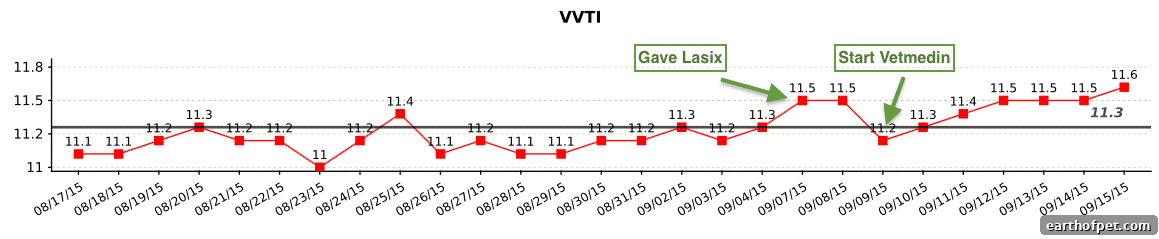
* VVTI, AN EXAMPLE OF HRV INDEX, SHOWING QUICK RESPONSE TO FUROSEMIDE AND A MORE GRADUAL BUT SUSTAINED RESPONSE TO VETMEDIN.
Activity levels, as recorded by the collar, did not show statistically significant decline before the CHF diagnosis, although a modest increase in activity was observed after medical stabilization. This emphasizes that changes in activity alone may be an insensitive marker for early cardiac deterioration, while physiological metrics such as pulse, respiratory rate and HRV provide earlier warning signs.
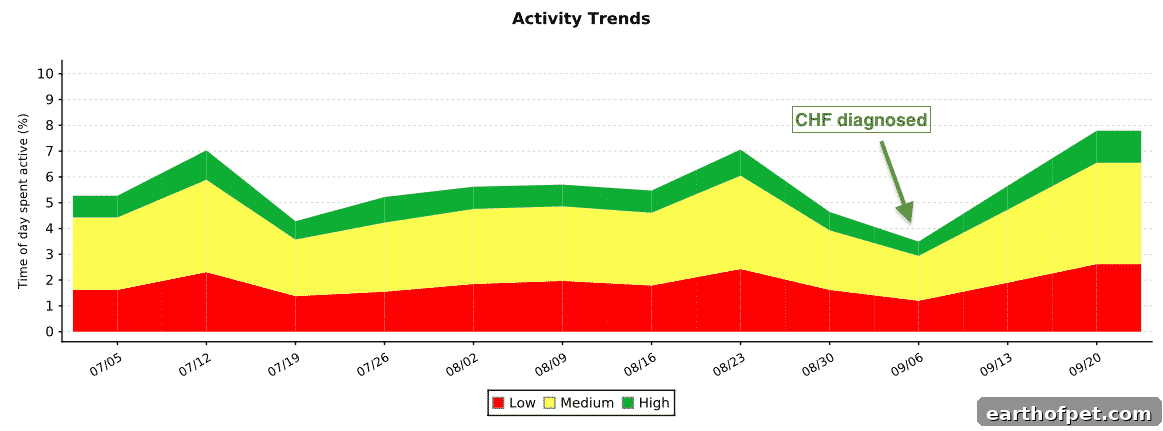
* WEEKLY ACTIVITY CHART FROM THE WEEKS BEFORE AND AFTER HEART FAILURE DIAGNOSIS.
Discussion
Chronic Valvular Heart Disease is a common degenerative heart condition, particularly in older small-breed dogs, though it can affect larger breeds as well. The disease causes structural valve changes that may progress to congestive heart failure in some patients. In Lucas’ case, progressive valve dysfunction manifested as gradual changes in vital sign trends that were captured remotely by the PetPace collar.
The case illustrates two important clinical points. First, continuous monitoring of physiologic parameters can reveal slow, clinically meaningful deterioration well before a pet develops clear outward symptoms. In Lucas the rising minimum pulse and respiratory rates plus falling HRV signaled decompensation ahead of the acute CHF diagnosis. Second, activity monitoring alone was less informative in the preclinical phase, reinforcing the value of comprehensive vital sign monitoring for cardiac patients.
Standard medical therapy for CHF secondary to CVHD includes diuretics such as furosemide to remove excess fluid and pimobendan (Vetmedin®) to support cardiac function. The effects of these treatments were evident in Lucas’ telemetry, with a rapid response to diuretic therapy followed by a more durable improvement after pimobendan was introduced. These objective signals assisted in assessing therapeutic response and guiding clinical decisions.
Conclusions
The PetPace smart collar offers unique capabilities for remote medical management of pets with cardiac disease. Continuous data capture enables early detection of physiologic trends that may precede overt clinical decline, and it allows clinicians to monitor treatment effects in near real time. For patients with Chronic Valvular Heart Disease and other progressive conditions, such remote monitoring can support more timely interventions and informed therapeutic adjustments.
Dr. Asaf Dagan, DVM, Diplomate ABVP (Canine and Feline practice) and PetPace’s Chief Veterinarian, observed that wearable technology now allows clinicians to remotely assess cardiac patients, detect concerning trends, and closely follow treatment responses—capabilities that may positively affect longevity and quality of life for affected pets.
Dr. Dan Ohad, DVM, PhD, Diplomate ACVIM and ECVIM (Cardiology), emphasized that trend data from a wearable device during hemodynamic deterioration and pharmacologic therapy have strong potential for earlier diagnosis and timely therapeutic decision-making, enabling clinicians to address adverse developments before they escalate.