
By: Janet Marlow
Contributors:
- Janet Marlow, Founder and Sound Behaviorist, Pet Acoustics.
- Dr. Asaf Dagan, Chief Veterinary Scientist, PetPace.
- Ron Pia, Founder, The Pet Calmer.
Originally published on: Pet Acoustics
Printed in: International Animal Health Journal (volume 9, issue 2), 2022
Canine hearing is far more sensitive than human hearing—dogs detect sounds from roughly 67 Hz up to 45,000 Hz, while humans typically hear between 20 Hz and 20,000 Hz. This heightened sensitivity means environmental sounds can trigger stress and anxiety in dogs. To address this, Janet Marlow, founder of Pet Acoustics, developed a science-based music process specifically tailored to canine, feline, and equine hearing.
Previous studies of Pet Acoustics’ species-specific music have shown behavioral calm and improved balance in animals. To expand on these findings, this four-month biometric study focused primarily on small dog breeds and measured physiological responses while the dogs listened to canine-specific music versus when no music was played. Small breeds were emphasized because they often exhibit higher levels of fear and anxiety—partly due to their size, owner handling practices, and heightened sonic sensitivity. Stress-related behaviors in small dogs can include repetitive grooming, pacing, and other compulsive actions. Demonstrating a measurable calming effect from species-specific music could offer a noninvasive tool to reduce chronic stress and improve long-term health.
Purpose of the Study

The study began in January 2022 to record each dog’s biological responses when Pet Acoustics’ canine-specific music was playing and when it was not. Music was played using the preloaded Pet Acoustics Pet Tunes Bluetooth® speaker placed near the dog. Ron Pia, a canine behaviourist in Australia, facilitated the study and provided the dogs. Owners volunteered their pets for supervised stay-over testing in a home environment. Each dog followed a normal daily schedule including rest, walks, and play.
Twenty dogs were monitored sequentially. Breeds included West Highland Terrier, Beagle, Long Haired Chihuahua, Cavalier King Charles Spaniel, French Bulldog, Lagotto Romagnolo, Pomeranian, English Springer Spaniel, Border Collie, Labradoodle, Poodle, and German Shepherd. Ages ranged from six months to twelve years. Real-time vital signs were recorded using the PetPace smart collar, which captured pulse rate, heart rate variability (HRV), and activity levels both while the music played and while it did not.

Pulse
Pulse or heart rate measures the number of heartbeats per minute and is a key vital sign. It reflects the body’s demand for oxygen—during exercise or stress, the heart rate increases to meet greater demand. Fear and anxiety also raise heart rate through activation of the fight-or-flight response. Monitoring pulse provides a direct physiological indicator of arousal and stress in dogs.
Heart Rate Variability (HRV)
HRV quantifies the small, natural variations in time between heartbeats. It is an established marker of autonomic nervous system balance: higher HRV typically signals better fitness and a calmer, more resilient physiological state, while lower HRV correlates with stress, pain, and certain illnesses. Changes in HRV can therefore indicate a shift in sympathetic (fight-or-flight) versus parasympathetic (rest-and-digest) activity.
Activity Score
The activity score is a composite value representing overall movement and behavior during the recorded period. Tracking activity patterns offers clinical insights—reduced activity can signal pain or illness, while some animals show increased activity during stress (e.g., pacing or vocalizing). The study evaluated activity alongside pulse and HRV to present a fuller picture of behavioral and physiological change.
Materials
Pet Acoustics and PetPace
The study combined two main tools: Pet Acoustics’ canine-specific music and the PetPace smart collar. Each dog wore the collar for approximately six hours during a 24-hour period while their biometric data were continuously recorded. Music was played for three hours and then turned off for the next three hours to enable direct comparison. Data collection occurred in real time and was accessible via a cloud-based analysis platform provided by PetPace.

Canine-Specific Music
Pet Acoustics’ canine-specific music is a science-based process created to reduce behavioral stress by tailoring instrumentation, frequency ranges, and volume levels to dogs’ acute hearing. Unlike human-directed music, these compositions are digitally modified to fit species-specific hearing comfort zones. Developed by Janet Marlow in 1997, this copyrighted method is designed to produce repeatable calming effects in dogs.
Methods
Each dog was fitted with the PetPace collar and monitored sequentially. Biometric readings were recorded every two minutes for a six-hour session, divided into three hours without music and three hours with music. During non-music periods, dogs experienced typical household sounds, walks, and play. Over the four-month period, the environment included intermittent external stressors such as thunderstorms. Multiple dogs shared the testing environment at times, reflecting a realistic home setting.
Results
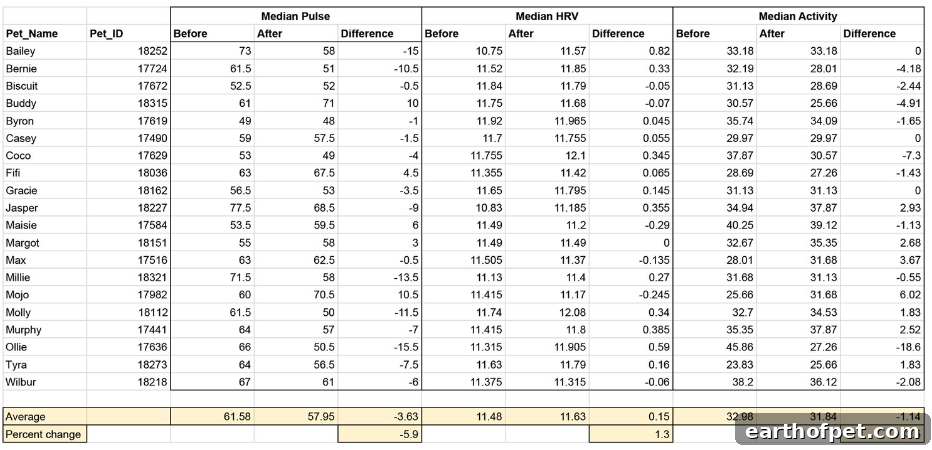
Aggregated data across all twenty dogs showed consistent physiological trends when dogs were exposed to the species-specific music. Median pulse decreased, median HRV increased, and median activity showed a slight overall decrease compared with periods without music.
Pulse
Overall, pulse rate declined with music exposure. The average of median pulse rates was 5.9% lower during music (57.95 bpm) than without music (61.58 bpm), indicating reduced physiological arousal.
HRV
HRV increased when music was playing, a sign of reduced sympathetic activation and greater autonomic balance. The study found the average median HRV was 1.3% higher during music (11.63) than when no music was played (11.48).
Activity
Activity responses varied among individual dogs: for half the dogs the median activity score decreased with music, while for the other half it increased. Overall, the average median activity score was 3.5% lower during music (31.84) compared with no music (32.98), suggesting a modest trend toward reduced restlessness for the group as a whole.
Conclusions
Biometric evidence from this study supports the hypothesis that Pet Acoustics’ canine-specific music promotes a calmer physiological and behavioral state in dogs. Lower pulse rates and higher HRV values indicate reduced sympathetic tone and decreased stress responses. HRV in particular showed meaningful elevation, consistent with improved autonomic balance.
Benefits for Canine Welfare
Results demonstrate that species-specific music can reduce stress-related behaviors in small dogs and produce similar biometric calming responses in larger dogs. The calming effect was observed across sex, age, breed, and neuter status, and in both indoor and outdoor settings. This suggests that canine-specific music can be an effective, noninvasive tool to mitigate environmental stressors regardless of training consistency or living conditions.
Applications and Practical Benefits
Veterinary clinics: Playing canine-calming music can lower stress during examinations and waiting-room stays, enabling better physical exams and more accurate vitals.
Additional Uses
- Support for dogs with separation anxiety
- Reduce stress in animal shelters
- Calm reactions to thunderstorms and fireworks
- Less stressful breeding and birthing environments
- Aid in post-surgery recovery
- Improve comfort during travel
By: Janet Marlow
Contributors:
- Janet Marlow, Founder and Sound Behaviorist, Pet Acoustics.
- Dr. Asaf Dagan, Chief Veterinary Scientist, PetPace.
- Ron Pia, Founder, The Pet Calmer.
Originally published on: Pet Acoustics
Printed in: International Animal Health Journal (volume 9, issue 2), 2022