Patient Condition and History
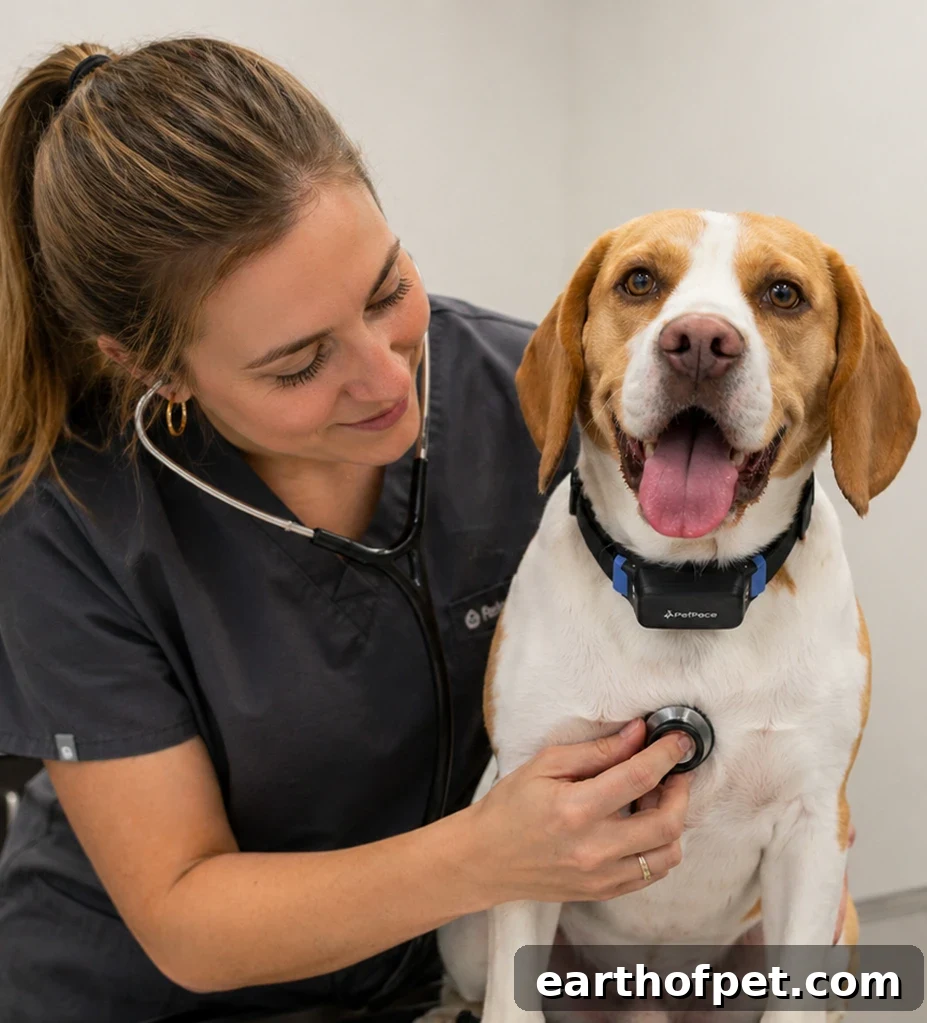
Jack is a five-year-old neutered male Shepherd-mix wearing a PetPace smart collar for long-term monitoring of epilepsy. Recently he developed an acute episode of gastroenteritis after ingesting deer feces while on a walk. Over several days Jack experienced vomiting, diarrhea, lethargy and loss of appetite and required veterinary care, including treatment with metronidazole and supportive care. He returned to his normal state after approximately five days.
Acute gastroenteritis in dogs commonly follows ingestion of contaminated material such as garbage, feces, carrion or other non-food items. Such exposures disrupt the intestinal environment and can trigger inflammation of the stomach and intestines, producing clinical signs that range from mild to severe. While many cases resolve without intensive intervention, some require veterinary assessment and medication to prevent complications such as dehydration or secondary infection.
Throughout Jack’s illness the PetPace collar recorded multiple physiological and behavioral changes that corresponded closely with his clinical signs.
Monitoring Data
Jack’s owner reported that symptoms began soon after the dog ingested deer feces. Over the next five days Jack showed diarrhea, reduced appetite and lethargy, and received veterinary treatment including metronidazole. The PetPace collar captured clear deviations from Jack’s baseline across several key metrics during this period.
Heart rate increased noticeably during the illness. Minute-by-minute pulse data accumulated a higher number of elevated readings on the days Jack was unwell, and the maximum pulse rate peaked acutely before gradually returning to baseline as he recovered.
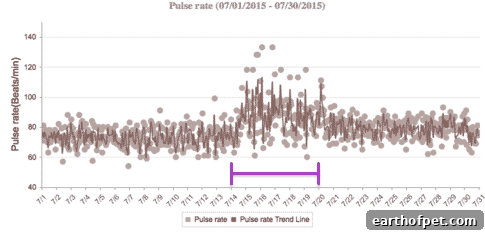
*MINUTE-BY-MINUTE MONTHLY PULSE TRACING, SHOWING AN ACCUMULATION OF ELEVATED PULSE DATA POINTS DURING THE DAYS OF GI DISTURBANCE.
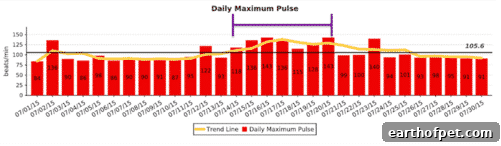
*ACUTE ELEVATION OF THE MAXIMUM PULSE RATE DURING THE DAYS OF ILLNESS.
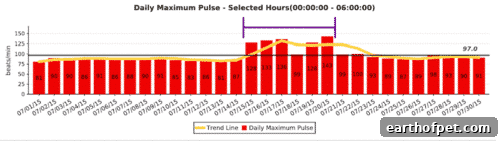
*THE ACUTE ELEVATION OF THE MAXIMUM PULSE RATE DURING SICKNESS BECOMES MORE OBVIOUS WHEN PULSE FROM THE NIGHT HOURS IS ISOLATED AND DISPLAYED.
Respiratory rate showed a milder and shorter-lived change. The PetPace records identified a transient rise in the minimum respiratory rate, particularly during nighttime hours; this change resolved after roughly three days.
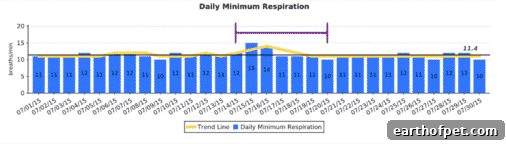
*MILD, TRANSIENT INCREASE IN MINIMUM RESPIRATORY RATE IN THE FIRST DAYS OF ILLNESS
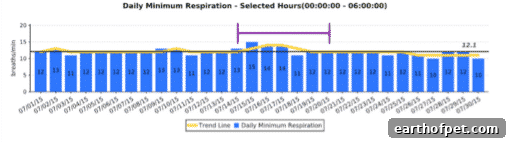
*ISOLATED NIGHTTIME MINIMUM RESPIRATORY RATE INCREASE IN THE FIRST DAYS OF ILLNESS
Activity levels fell during the sick period and then rose back to Jack’s normal pattern as clinical signs resolved. Reduced movement and energy are common signs of systemic illness and were reflected in the collar’s activity chart.
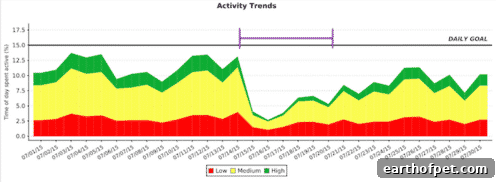
*ACTIVITY CHART SHOWING OVERALL DECREASE IN ACTIVITY LEVEL DURING SICK DAYS.
Behavioral-position data also shifted: Jack spent less time standing and more time lying down, consistent with lethargy and weakness observed by his owner. Position tracking offers a useful behavioral signal that complements vital sign changes when evaluating a dog’s condition.
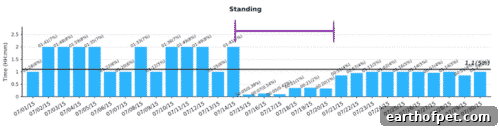
*STANDING POSITION TREND CHART SHOWING DECREASE IN TIME SPENT STANDING DURING SICK DAYS.
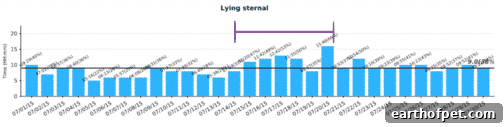
*LYING STERNAL POSITION TREND CHART SHOWING INCREASE IN TIME SPENT LYING DOWN DURING SICK DAYS.
Heart rate variability (HRV), a sensitive indicator of stress and pain, declined during the illness and gradually recovered afterward. Different HRV indices provided complementary views: the Triangular Index showed an acute decrease during the sick period with a slow return to baseline, while the Vaso-Vagal Tonus Index (VVTI) — already typically low for Jack due to his epilepsy — displayed an increased proportion of low (red) data points during illness, rising from 5.7% at baseline to 14.5% during the affected days.
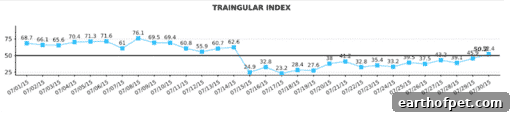
*HRV (TRIANGULAR INDEX) SHOWING ACUTE DECREASE DURING ILLNESS AND SLOW, GRADUAL RETURN TO NORMAL LEVELS.
Another clear finding was complete absence of time spent in the eating/drinking position for five days beginning the day after exposure, matching the owner’s observation of inappetence during Jack’s illness.
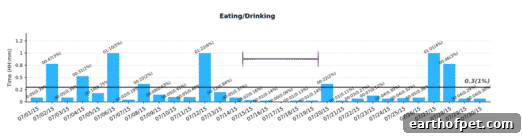
*EATING/DRINKING POSITION CHART DOCUMENTING INAPPETENCE DURING THE DAYS OF ILLNESS.
Discussion
The combined data from heart rate, respiration, activity, body positions and HRV provided a coherent and time-correlated signal of Jack’s acute gastrointestinal illness. Vitals and behavioral metrics diverged from baseline during the five-day episode, with the most pronounced and prolonged change seen in pulse rate. Elevated pulse in the context of reduced activity is particularly suggestive of an underlying health problem rather than simple exertion.
Nighttime measurements highlighted these changes more clearly because daily activities and environmental factors are minimized at night, reducing confounding influences on pulse and respiratory readings. HRV again proved useful as a general indicator of physiological stress; different HRV measures can reveal both acute impact and a slower physiological recovery that may continue even after outward symptoms improve.
Conclusions
The PetPace smart collar provided rich, continuous data that helped document the onset, severity and recovery of Jack’s acute gastroenteritis. Timely detection of deviations from each dog’s typical patterns — including heart rate, respiration, activity, posture and HRV — can serve as an early warning system for owners and veterinarians. These objective measurements allow clinicians to confirm a problem, assess severity, guide treatment, and monitor response and recovery in real time.
Dr. Asaf Dagan, DVM, Diplomate ABVP (Canine and Feline Practice) and PetPace Chief Veterinarian, commented that the changes observed are not specific to gastroenteritis but are valuable indicators of an acute health problem that should prompt veterinary evaluation. Jack’s owner, Mr. Ken Herring of Grosse Ile, MI, added that having quantitative data made it easier to see that the prescribed medication was effective and that no more serious condition was present.