Introduction
Nix is a four-year-old, spayed female Pitbull mix weighing 43 lbs. She underwent tibial plateau leveling osteotomy (TPLO) at TotalBond Veterinary Hospital in Gastonia, NC, to repair a torn ligament in her right knee. Following surgery, a PetPace smart collar was placed to provide continuous, objective monitoring during her recovery.
The PetPace collar captured physiologic and behavioral data that proved useful in identifying early signs of discomfort and guiding timely intervention. The following sections summarize how pulse, heart rate variability, and activity metrics helped the clinical team evaluate Nix’s post-operative pain and response to analgesia.
Pulse
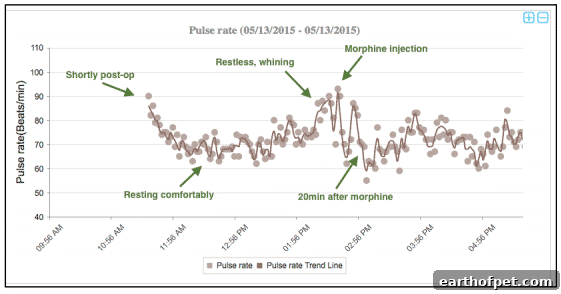
Heart rate monitoring after surgery is a simple but powerful indicator of physiologic stress or pain. In Nix’s case, the collar recorded several hours of stable, low pulse values as she rested peacefully. Later, however, the collar detected a sustained rise in pulse rate that coincided with observed behavioral signs of distress—restlessness and vocalization.
Those combined data prompted the attending veterinarian to administer a dose of morphine. After the analgesic was given, Nix’s pulse returned toward baseline and she appeared to settle, demonstrating how continuous monitoring can support prompt clinical decisions and improve post-operative comfort.
Heart Rate Variability (HRV)
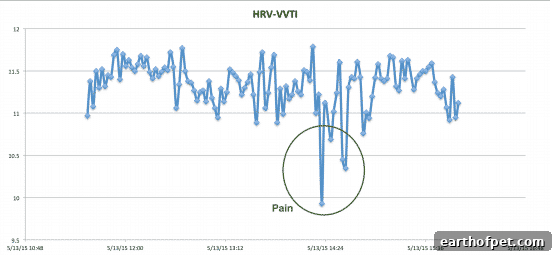
Heart rate variability (HRV) measures the variation in time intervals between successive heartbeats. Clinically, lower HRV is associated with physiologic stress and has been correlated with pain in both human and veterinary settings. One commonly used index of HRV is the Vaso-Vagal Tonus Index (VVTI).
The PetPace collar recorded a sharp decrease in Nix’s VVTI that coincided with the clinical signs of pain and the rise in pulse rate. This corroborating physiologic signal strengthened the assessment that Nix was experiencing discomfort. After morphine administration, the VVTI improved, returning to levels consistent with relaxation and recovery.
Activity
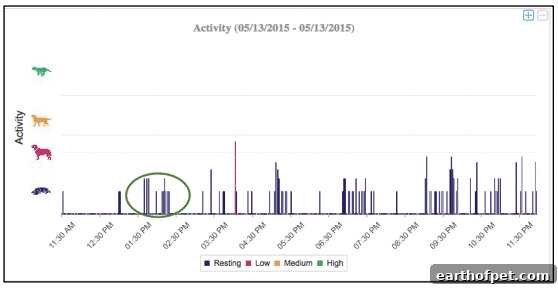
Activity monitoring complements physiologic measurements. Accelerometer-based activity tracking provides objective data on movement patterns that can signal restlessness, pacing, or reduced mobility—behaviors often associated with pain or discomfort.
In Nix’s post-operative period, the PetPace collar recorded an acute spike in activity that matched the timing of the increased pulse and decreased HRV, indicating that she was moving more and likely uncomfortable. After the clinical team administered morphine, activity levels declined and returned to baseline, reflecting a behavioral response to effective analgesia.
Clinical Significance
This case highlights how integrated, continuous monitoring with a smart collar can enhance post-operative care. By combining pulse, HRV (VVTI), and activity measures, the veterinary team was able to detect an episode of pain early, confirm it with multiple objective signals, and evaluate the patient’s response after analgesic treatment. The multimodal data provided by the PetPace collar offered timely information that supported clinical decision-making and likely contributed to a smoother recovery for Nix.
Using objective physiologic and behavioral metrics alongside standard clinical assessment improves the ability to recognize pain that might otherwise be missed or delayed, especially in hospitalized animals where subtle signs can be overlooked. These tools do not replace clinical judgment; rather, they augment it by providing continuous data that can trigger reassessment and, when needed, prompt intervention.
Summary
The Nix case demonstrates the practical value of wearable veterinary monitoring technology in a post-operative setting. Continuous tracking of heart rate, heart rate variability, and activity provided corroborating evidence of pain and validated the effectiveness of analgesic treatment. These findings underscore the potential role of smart collars in improving patient comfort, enhancing recovery monitoring, and supporting evidence-based pain management protocols.
References
Arras M, et al. Assessment of post-laparotomy pain in laboratory mice by telemetric recording of heart rate and heart rate variability. BMC Vet Res 2007;3:16.
Pereira YM, et al. The vasovagal tonus index as a prognostic indicator in dogs with dilated cardiomyopathy. J Small Anim Pract. 2008 Nov;49(11):587-92.
Brown DC, et al. Use of an activity monitor to detect response to treatment in dogs with osteoarthritis. J Am Vet Med Assoc. 237: 66-70, 2010.