
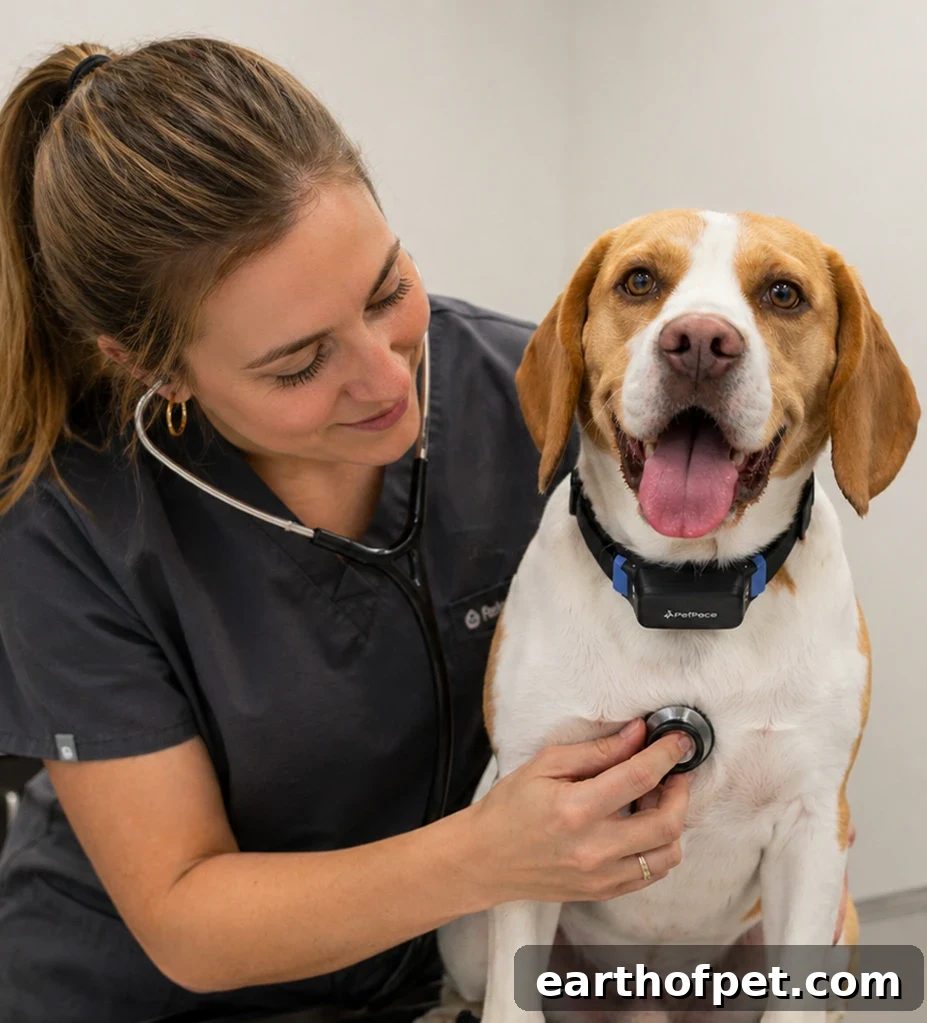
A 6-year-old Labrador walks into a clinic with a wagging tail and the technician records a heart rate of 124 beats per minute. The owner turns worried. Two nights later the same dog is asleep on the couch and, with a hand on her ribs, the pulse measures closer to 55.
Both readings can be correct. They reflect two different situations: one measurement taken in an exam room where the dog is alert or anxious, the other taken at home while the dog is relaxed. This article explains what a normal dog heart rate looks like at home, how size, age, sleep and seasons affect it, how to measure it yourself, and when a number warrants contacting your veterinarian.
The short answer: Most healthy adult dogs have a resting heart rate at home of roughly 55 to 65 beats per minute, with a median near 60, according to a 2025 study of 703 dogs. Clinic reference ranges (often 60 to 140) are wider because stress and excitement during visits push the pulse higher. Smaller dogs and puppies tend to have faster heart rates, while large dogs run slower.
Medically reviewed by Asaf Dagan — Co-Founder and Chief Veterinary Scientist at PetPace
What is a normal dog heart rate at home?
When a dog is calm and lying down at home, most healthy adults fall between about 55 and 65 beats per minute. The largest home-based dataset published so far reports a median of about 60.5 bpm.
That dataset comes from a 2025 multi-country study that monitored 703 apparently healthy dogs for several months and recorded only periods when the dog was motionless, giving a picture of true resting physiology rather than activity-driven results.
Clinic charts that list higher ranges are not wrong — they reflect measurements taken in the veterinary setting, where excitement or stress elevates the pulse. In short: clinic numbers tell you how a dog tolerates the clinic; home numbers show baseline heart function in familiar conditions.
Two important cautions from the study: health status was based on owner reports rather than a full veterinary exam, so a few dogs with early disease might have been included; and some authors are affiliated with the manufacturer of the monitoring device used. The work is peer-reviewed and useful, but it is one study among others.
Heart rate by dog size: small dogs run faster, but not dramatically
Smaller dogs tend to have faster heart rates, but at rest the difference is smaller than many older charts imply. In the home study, dogs weighing 22 pounds (10 kg) or less had a median resting rate of about 65 bpm, while dogs over 44 pounds (20 kg) had a median near 59.5 bpm.
| Dog size | Typical clinic reference, resting (clinic charts) | Home resting median (2025 home study) |
| Small | 90 to 120 bpm | 65.0 (dogs 22 lb / 10 kg or less) |
| Medium | 70 to 110 bpm | 62.1 (pooled up to 44 lb / 20 kg) |
| Large | 60 to 90 bpm | 59.5 (dogs over 44 lb / 20 kg) |
Previous clinic-based research found roughly a 10-beat difference between very small and very large dogs, so the trend is consistent: weight influences heart rate but the exact gap depends on where and how the rate is measured.
Breed differences are generally modest. In the home study, several common breeds clustered around the high-50s to mid-60s. Sample sizes per breed were small, so use breed medians as a rough guide only — your individual dog’s baseline is far more meaningful.
How age, sleep and season influence heart rate
Puppies have faster hearts, adults settle into a lower range, and older dogs often show a slight increase. Sleep and time of year also shift numbers subtly.
In the home dataset, puppies under 12 months had a median resting rate around 78.5 bpm. Adults aged 1 to 10 averaged about 59 bpm, and dogs 10 and older had a median near 68.7 bpm. The senior rise is modest and may reflect aging or unrecognized health issues.
Time of day matters: the median between midnight and 6 a.m. was about 58.3 bpm, versus 61.3 bpm during waking hours. Seasonal effects were seen too — dogs in the Northern Hemisphere had slightly lower resting rates in late summer and early autumn compared with winter, while panting and breathing rates rose in hot months.
Always interpret a single pulse in context. A resting 70 bpm means something different for a young, active breed with a low median than for a senior dog of any breed.
How to check your dog’s pulse at home
Place your hand flat on the dog’s left chest where the elbow meets the ribs and feel for the heartbeat. Count beats for 15 seconds and multiply by four. Do this while your dog is calm and lying down. If you can’t detect the heartbeat there, feel the femoral pulse on the inside of the upper thigh, near the groin.
Take several readings across different days but in similar conditions (always relaxed or asleep, never just after exercise or an exciting event). Record each measurement and average them to establish your dog’s baseline.
It can be trickier than expected: small dogs, deep or furry chests, rapid pulses and your own heartbeat in your fingertips can all cause miscounts. If you struggle, count breathing instead or ask your veterinarian to demonstrate the best spot during your next visit.
When to call your veterinarian about heart rate changes
A single unusual reading usually isn’t urgent. Persistent elevation above your dog’s baseline for days, or any pulse change that accompanies symptoms, merits a phone call to your vet.
Resting rates overlap between healthy dogs and those with heart disease, so trends matter more than any single cutoff. The same home study reported a median resting rate of 67.3 bpm for dogs with known heart disease versus 60.5 bpm in healthy dogs — a difference, but with overlapping ranges.
In one described case, a dog’s resting rate rose gradually over about 120 days before fluid accumulated in the lungs; the owner had not noticed the trend. This anecdote doesn’t prove predictability, but it illustrates why veterinarians track direction over time.
Breathing rate measured during sleep is an especially reliable home signal. Cardiologists commonly use about 30 breaths per minute as a threshold worth reporting; in one study the median sleeping respiratory rate in dogs with controlled left-sided heart failure was 20 breaths per minute, and most dogs were well below 30.
Seek immediate veterinary care without counting if your dog collapses or faints, shows pale or bluish gums, struggles to breathe, or develops a new cough with rapid breathing. Never change medications based on a home reading without consulting your veterinarian.
Where continuous monitoring fits
A 15-second pulse check gives a snapshot that covers less than 0.1% of the day. It misses night-day swings, post-meal rises, and gradual drifts that appear only over weeks. Continuous monitoring devices can record pulse, respiration, temperature, activity and sleep around the clock to reveal an individual dog’s pattern rather than a single number. Such data can be shared with your veterinarian to add context to clinical decisions, but it does not replace a physical exam or formal cardiac tests when problems are suspected.
FAQ
What is a normal heart rate for a dog while sleeping?
In the 2025 home study, the median between midnight and 6 a.m. was about 58 beats per minute — roughly three beats lower than daytime values. Individual variation and dreaming can cause short spikes, so count over a minute or two and take several readings on different nights to determine your dog’s sleeping baseline.
Is 120 beats per minute normal for a dog?
At the clinic, for a small or excited dog, 120 bpm can be normal. For an adult dog lying calmly at home, 120 is much higher than the typical 55 to 65 range. Recheck when your dog is relaxed; if the rate remains elevated or is accompanied by coughing, fatigue or rapid breathing, contact your veterinarian.
Should a dog’s heartbeat be irregular?
A normal respiratory-linked variation (speeding slightly on inhalation and slowing on exhalation) is common. Skipped beats, stalls or chaotic rhythms are different and deserve veterinary evaluation. A stethoscope exam or further testing may be needed to assess rhythm problems.
How do I check my dog’s heart rate without a stethoscope?
Rest your palm on the left side of the chest just behind the elbow while the dog is calm. Count for 15 seconds and multiply by four. Repeat across several days and average the values. If you can’t get a reliable count, measure resting breathing rate instead and ask your vet to demonstrate the correct technique.
Do senior dogs have a higher resting heart rate?
On average, yes. The 2025 home study found dogs aged 10 and older had a median resting rate around 68.7 bpm versus about 59 bpm in adults aged 1 to 10. The rise may reflect aging or unrecognized conditions, so knowing your senior dog’s personal baseline and reporting sudden changes is important.
Know your dog’s baseline
Instead of relying on generic charts, take three or four heart rate readings this week while your dog is relaxed or asleep, record them, and use that average as your dog’s baseline. The right question is not “is 62 normal?” but “is 62 normal for my dog, and has it changed?”
If you prefer not to count manually, continuous monitoring devices are available that record resting pulse and breathing and build a baseline automatically. Whichever method you choose, bring your recorded numbers to your veterinarian at the next visit.
Sources
- Chetboul V, Humbert E, Dougoud L, Lorre G (2025). Resting heart and respiratory rates in dogs in their natural environment (the AI-COLLAR study). Frontiers in Veterinary Science 12:1667355.
- Animal Medical Center of New York (updated Oct 2025). Vital Signs: Know What’s Normal for Your Pet.
- Hezzell MJ, Humm K, Dennis SG, Agee L, Boswood A (2013). Relationships between heart rate and age, bodyweight and breed in 10,849 dogs. Journal of Small Animal Practice 54:318-324.
- Porciello F, Rishniw M, Ljungvall I, Ferasin L, Haggstrom J, Ohad DG (2016). Sleeping and resting respiratory rates in dogs and cats with medically-controlled left-sided congestive heart failure. The Veterinary Journal 207:164-168.