Picture a 12-year-old tabby named Pickle on the exam table: ears flattened, pupils wide, a heart rate recorded at 240 beats per minute and rapid, shallow breathing. Two hours later she’s asleep on the couch, breathing slowly and evenly, and nobody would guess anything was wrong. Which Pickle is the real one? Most often it’s the relaxed, sleeping one.
That gap is why cat vitals are harder to interpret than dog vitals, and why a home baseline matters more than a single clinic reading. This guide explains the heart rate and breathing rate ranges veterinarians use, how to measure them without stressing your cat, and which changes should prompt a call to the clinic.
Quick answer: A healthy adult cat’s heart rate typically falls roughly between 140 and 220 beats per minute in the exam room and is often lower at home. A sleeping cat usually breathes fewer than 30 times per minute. Your cat’s individual baseline is the most useful reference; a sleeping rate that stays above 30 or a sustained rise well above your cat’s normal pattern deserves veterinary attention.
What is a normal heart rate for a cat?
Most veterinary sources list a resting heart rate for adult cats of about 140 to 220 beats per minute. That is a wide range: a relaxed cat at home will usually sit in the lower half, while a nervous cat in the clinic can reach or exceed the upper end. Kittens typically have faster heart rates than adults. Activity, excitement, or even being picked up can double a cat’s heart rate within seconds.
Because of that variability, a single heart rate number tells you little by itself. A cat that is usually 150 while calm but is measured at 210 when resting is a more meaningful change than a single chart value. Persistent rates above about 240 or below about 120 are generally considered abnormal by veterinary references and require a veterinary exam.
How do you check a cat’s pulse at home?
To feel a cat’s pulse, rest two fingers on the inside of the hind leg near the groin to locate the femoral artery, or place your hand gently against the chest behind the front elbow. Count the beats for 15 seconds and multiply by four. Stop if your cat becomes tense—stress will change the reading and doesn’t reflect a true baseline.
Finding a pulse can be challenging: cat pulses are fast and often faint, and many cats resist being held. If you can’t locate a clean pulse after a couple of calm attempts, don’t force it. For many owners, breathing rate is easier to measure and, for cats, often more informative.
Helpful tips: pick a time when your cat is drowsy after a meal, keep the environment quiet and warm, take readings on different days, and record each measurement. Comparing home and clinic numbers for the same cat—such as 160 at home versus 190 at the vet—helps you understand typical variance.
What is a normal breathing rate for a cat?
A healthy cat usually breathes fewer than 30 times per minute while asleep or resting quietly. Veterinary cardiology services commonly cite roughly 15 to 30 breaths per minute at rest and consider sustained rates above about 30 to be increased. Awake but calm cats generally breathe a little faster than sleeping ones.
Research supports these ranges. A study published in the Journal of Feline Medicine and Surgery (Ljungvall et al., 2014) asked owners to count sleeping and resting respiratory rates at home for groups of echocardiographically normal cats and cats with subclinical heart disease. Typical sleeping rates centered around 19 breaths per minute in healthy cats and about 21 in cats with subclinical disease. Resting (awake) rates were higher, with medians near 25–27. Repeated sleeping counts at or above 30 were uncommon in both groups.
A single elevated count does not equal a diagnosis. The study and clinical guidance emphasize that repeatedly elevated sleeping rates are the more important signal that warrants further veterinary evaluation.
How do you count a cat’s sleeping breathing rate?
Wait until your cat is truly asleep, not merely resting with closed eyes. Observe the chest or flank and count each full rise and fall as one breath. Time for 30 seconds and double the number, or count for a full minute for greater accuracy. Avoid counting while your cat is purring, which alters the breathing rhythm.
Take daily readings for a week to establish a baseline, then a few times weekly thereafter. Record each measurement. A short phone video of the sleeping cat lets you count later if the cat wakes when you lean in. A practical recommendation from clinical practice is to treat a sustained rise of about 20 percent above the cat’s own baseline as worth contacting your veterinarian, even if the number remains under 30, and to confirm elevated readings across two or three sessions before calling.
Why are cat vitals different at the vet?
Clinic visits commonly raise stress in cats, and stress increases both breathing and heart rate. Studies comparing clinic and at-home assessments show that cats inspected in a clinic setting display more stress-related signs—faster breathing, dilated pupils and defensive ear positions—than the same cats observed at home.
Environment matters: noise, unfamiliar people and handling all raise stress. For example, research tracking cats in wards with varying noise levels found that breathing rate closely followed combined stress scores, with louder wards associated with higher breathing rates. A breathing rate taken in a loud, unfamiliar room therefore reflects the environment as much as the cat.
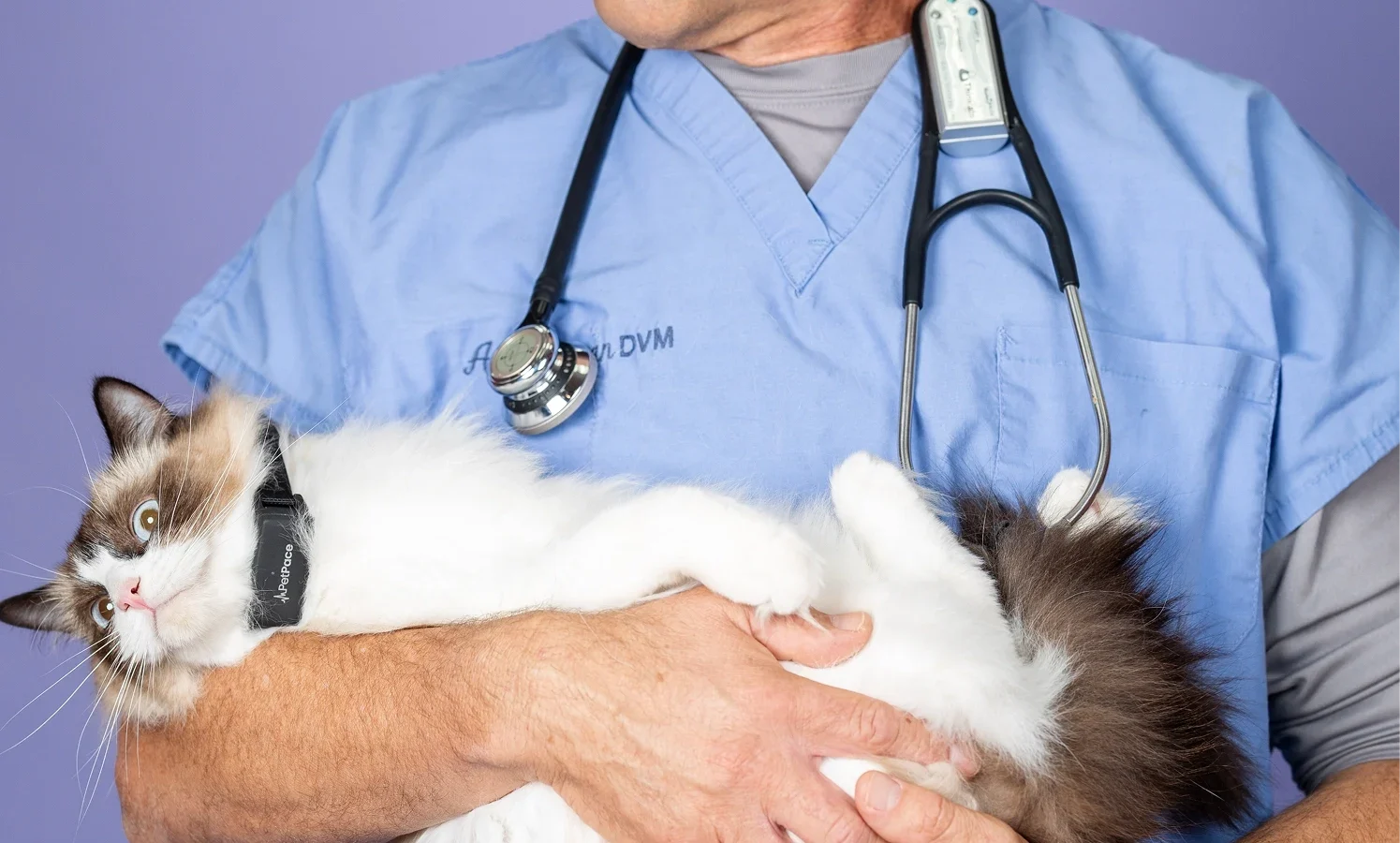
That is why veterinarians often ask for home measurements. Cats are adept at hiding illness, and a cat with a slowly developing condition may appear normal during a short clinic exam. Continuous or repeated calm readings taken at home give your veterinarian a reliable baseline clinics cannot easily produce. Some owners use wearable devices such as smart collars to record trends over time; these devices can help document changes but do not replace a veterinary exam.
What changes should you call your vet about?
Contact your veterinarian if a sleeping breathing rate remains above about 30 on repeated counts, if it climbs well above your cat’s established baseline, or if your cat’s heart rate is far outside its usual range while calm. Seek emergency care immediately for open-mouth breathing, labored or visibly effortful breathing, blue or gray gums, sudden weakness, or collapse.
Cats seldom cough or pant like dogs, so rapid breathing is often the earliest visible sign of a chest or cardiac problem. Causes of increased breathing or heart rate include heart disease, lung or airway disorders, pain, fever, anemia or thyroid disease. Only a veterinary exam and appropriate testing can determine the cause. Home measurements alert you and your vet earlier but do not diagnose conditions.
For senior cats or breeds predisposed to heart disease—such as Maine Coons and Ragdolls—building a baseline while they are well is especially valuable.
Frequently asked questions
What is the normal heart rate for a cat at rest?
Typical references list about 140 to 220 beats per minute for an adult cat at rest, with calm cats at home often on the lower side. Your cat’s own baseline is the best benchmark. Persistent rates well above or below the usual range merit veterinary evaluation.
What is a normal respiratory rate for a cat?
A healthy sleeping cat typically breathes fewer than 30 times per minute, with many averaging about 15 to 25. Resting awake cats breathe a bit faster. Repeated sleeping counts above 30 should be discussed with your veterinarian.
How do I count my cat’s breaths?
Wait until your cat is fully asleep and not purring. Count each rise and fall of the chest for 30 seconds and double it, or count for a full minute. Record the number and repeat across several days to establish a baseline.
Why is my cat’s heart rate higher at the vet?
Fear and handling increase heart rate and breathing in many cats. Studies show more stress-related signs and faster breathing during clinic visits than in home assessments, so exam-room numbers often overstate the resting rate.
Can a smart collar tell me what’s wrong with my cat?
No. A smart collar can reveal trends in vital signs over time, helping your veterinarian detect changes you might miss. It does not diagnose specific diseases; abnormal readings still require a clinical exam.
When is fast breathing an emergency?
Open-mouth breathing, obvious effort with each breath, blue or gray gums, sudden collapse or profound weakness are emergencies that need immediate veterinary attention. Do not wait to retake measurements if any of those signs are present.
The bottom line
Caring for cats means working around their tendency to hide illness and to stress in unfamiliar settings. The most practical approach is to build a calm baseline: several sleeping breathing counts recorded over a couple of weeks so you and your veterinarian know what “normal” looks like for your cat. If you prefer continuous monitoring, wearable devices exist that record trends, but any concerning change still needs veterinary assessment.
Medically reviewed by Dr Asaf Dagan. This article provides general information and is not a substitute for veterinary advice. Consult your veterinarian about any change in your cat’s health.
Sources
- Ljungvall I, Rishniw M, Porciello F, Häggström J, Ohad D. Sleeping and resting respiratory rates in healthy adult cats and cats with subclinical heart disease. Journal of Feline Medicine and Surgery, 2014;16(4):281-290. doi:10.1177/1098612X13508940
- Texas A&M University College of Veterinary Medicine, Cardiology Service. Measuring Your Pet’s Breathing Rate (client information sheet).
- UC Davis Health. Research on telemedicine and feline assessments (January 2023).
- Girão M, Stilwell G, Azevedo P, Carreira LM. The Influence of Noise Level on the Stress Response of Hospitalized Cats. Veterinary Sciences, 2024;11(4):173.
- Davis H. The 60-second check that can change outcomes for HCM patients. Veterinary Practice News, August 2026.