PetPace Smart Collar Enables Continuous Core Temperature Monitoring in Veterinary Medicine
PetPace, maker of an innovative IoT-enabled smart collar for remote, real-time monitoring of pet vital signs and activity, published a new medical case study documenting a milestone in veterinary care. The study, available for download from PetPace, details how the PetPace collar enabled continuous, non-invasive, minute-by-minute monitoring of core body temperature in a clinical patient—a capability not previously available for conscious companion animals.
Case summary: Ginger, a 10-year-old Weimaraner
The case follows Ginger, a 10-year-old spayed female Weimaraner who was admitted to a specialty referral veterinary hospital after her owner noticed a neck swelling, difficulty eating, lethargy, and fever. During a four-day hospitalization and subsequent follow-up, Ginger underwent diagnostic testing and treatment and was ultimately diagnosed with sialoadenitis, an inflammation of the salivary glands.
A PetPace smart collar monitored Ginger’s vital signs continuously, including core body temperature, and delivered minute-by-minute data to the PetPace Professional Control Center. The information was displayed in real time on a monitor placed near Ginger’s cage in the ICU and was available to clinicians and the pet’s family. The collar accompanied Ginger from initial admission through discharge and into the home environment for follow-up monitoring.
Why continuous temperature monitoring matters
Core body temperature is a fundamental clinical parameter that helps veterinarians assess infection, inflammation, and response to treatment. Traditionally, veterinarians measure temperature with a rectal thermometer. While accurate, rectal measurements are uncomfortable for patients, provoke resistance in many animals, and are impractical to perform continuously. As a result, even hospitalized pets often have their temperature checked only a few times per day.
Before devices like the PetPace collar, continuous, accurate core temperature monitoring of conscious patients was essentially unavailable in routine veterinary practice. Continuous monitoring traditionally required specialized equipment reserved for sedated or obtunded patients. For pet owners, reliable home temperature monitoring was effectively impossible without training and specialized tools.
Clinical impact in Ginger’s recovery
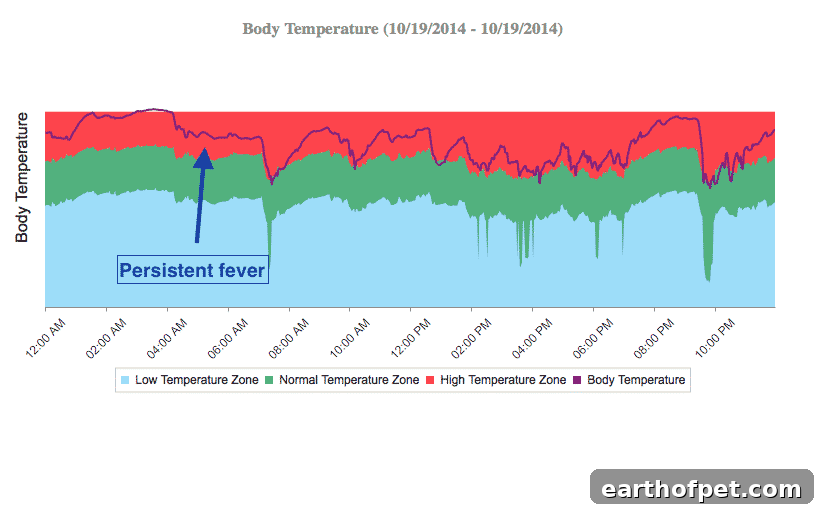
In Ginger’s case, the PetPace collar accurately captured the onset and resolution of fever. During the first three days of hospitalization the collar consistently documented fever. After clinicians added Prednisone and Phenobarbital to the treatment protocol, the collar recorded the fever’s gradual decline and eventual resolution on the morning of the fourth day. Following discharge, the collar continued to record normal temperatures at home, providing objective reassurance that Ginger was recovering as expected.
These high-resolution temperature trends offered clinicians timely insight into Ginger’s response to therapy—information that influenced clinical decision making without subjecting the patient to repeated intrusive measurements. The continuous data stream removed uncertainty and showed not only that fever was present, but also how it changed hour by hour, informing treatment adjustments and discharge planning.
Veterinary perspectives and broader implications
“Remote, continuous, and accurate core temperature assessment of conscious patients was not possible prior to this technology,” said Dr. Asaf Dagan, DVM, Diplomate ABVP (Canine and Feline practice) and PetPace’s Chief Veterinarian. The ability to monitor temperature with high temporal resolution—both in the hospital and at home—enables earlier detection of clinically significant changes that can affect outcomes.
Dr. Teresa Lightfoot, DABVP, from BluePearl Veterinary Partners Specialty and Emergency Center in Tampa, FL, where Ginger was hospitalized, noted that intensive monitoring is often required in referral centers. She observed that the previously unavailable high-resolution temperature data from the PetPace collar proved useful for managing this challenging case and documenting the patient’s response to treatment.
Advantages of smart-collar monitoring
Key advantages demonstrated in this case include:
- Continuous, minute-by-minute core temperature assessment without invasive probes or repeated handling;
- Real-time delivery of data to clinicians and caretakers for timely clinical decisions;
- Seamless transition of monitoring from hospital to home, supporting post-discharge follow-up;
- Support for broader vital sign analysis alongside activity metrics, enabling a more complete picture of patient status.
The PetPace smart collar represents a practical tool for veterinarians who need reliable, ongoing monitoring of core physiological parameters. By providing continuous, non-invasive temperature monitoring, the device supports improved case management, enhances clinician confidence in treatment response, and reduces stress for patients and owners.
The detailed case study describing Ginger’s monitoring and recovery is available for download from PetPace for clinicians and pet owners interested in how continuous smart-collar monitoring can augment veterinary care.