

Patient Condition and History
Pippa is a nine-year-old, 61 lb spayed female Labrador Retriever with a long-standing history of hip dysplasia. Hip dysplasia is a common joint disorder, particularly in larger dog breeds, that results from abnormal development of the hip joint. This malformation produces looseness in the joint, followed by progressive degeneration, inflammation and, in many cases, chronic pain. Because pets often mask discomfort, careful monitoring is crucial to detect and manage pain early.
To better assess Pippa’s daily health and to monitor potential pain related to her hip disease, her caregivers fitted her with a PetPace collar. The collar continuously records physiological and behavioral parameters, allowing both real-time and long-term analysis of trends that can indicate pain or reduced wellbeing.
Monitoring Data
Data from the PetPace Health Report compared Pippa’s measurements to reference values for dogs of similar breed, age, weight and sex. Key findings include:
- Pulse: Pippa’s average pulse was 74 bpm (range 51–123), which is slightly better than the comparator group of female Labradors of the same age and weight (average 79 bpm; range 49–108).
- Respiration: Her average respiratory rate was 17 breaths per minute (range 10–26), closely matching the reference group average of 20 (range 9–29).
- Resting Time: Pippa spent 90.8% of recorded time resting. While the overall species average is approximately 81%, Labradors of her age and weight typically rest around 92% of the time, making Pippa’s rest time comparable to peers.
- Body Positions: Most dogs in the reference set spend about 13% of rest time lying on their left side; Pippa lay on her left side only 8% of the time. A reduced preference for a particular resting position can indicate discomfort or pain when lying that way.
- Heart Rate Variability (HRV): Overall HRV indices, including VVTI (Vaso-Vagal Tonus Index), were within normal ranges (VVTI average 11.5). HRV is a recognized objective marker that can reflect stress, autonomic balance and pain.
Daily variation in most of Pippa’s recorded values was low, suggesting stable baseline physiology. However, HRV occasionally dropped to lower levels, a fluctuation that may reflect intermittent episodes of pain or discomfort.
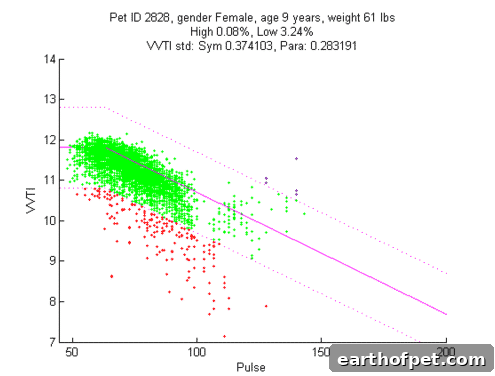
*Pippa’s VVTI vs. pulse chart showing an elevated proportion of points below the normal range (red points).
To explore the intermittent HRV changes in more detail, caregivers plotted minute-by-minute VVTI against simultaneous pulse readings. Preliminary analyses show that a higher-than-normal proportion of points falling below the normal VVTI range correlates with a range of medical issues. In Pippa’s case, 3.2% of the plotted data points fell below the expected range, a percentage higher than typical for healthy dogs.
Discussion
Although Pippa does not display obvious, continuous signs of pain, the PetPace data suggest mild, intermittent discomfort consistent with the inflammatory nature of hip dysplasia. Her vital signs—pulse and respiration—were normal and, in some respects, slightly better than comparable dogs. Yet two independent signals from the collar raise concern: deviations in resting position preference and episodic drops in HRV.
Intermittent reductions in HRV can indicate temporary increases in sympathetic tone or autonomic imbalance, which are commonly associated with pain or stress. For pets with inflammatory joint disease, such ups and downs are expected: factors like activity, weather, diet, or spontaneous flare-ups of inflammation can trigger short bouts of pain.
The positional data further supports this interpretation. Pippa’s reduced time lying on her left side suggests she may avoid that position because it elicits discomfort in a painful hip. While neither HRV nor position data alone is specific to hip dysplasia, together they form a consistent pattern indicating a problem that warrants attention.
Pippa’s owner, Dr. Nitzan Kroter, a veterinary surgeon based in Enfield, UK, reports no evidence of other concurrent medical conditions. Given Pippa’s history and the collar’s findings, Dr. Kroter interprets the data as indicative of chronic, intermittent pain related to her hip dysplasia.
Detecting chronic and intermittent pain in animals is a persistent challenge in veterinary medicine. Pets often adapt their behavior and can appear content while still experiencing meaningful discomfort. As Dr. Asaf Dagan, PetPace’s Chief Veterinarian, notes, long-term monitoring and comparison with individualized baselines can uncover pain that owners and clinicians might otherwise miss.
“Pippa is a happy dog despite her condition,” says Dr. Kroter. “The collar provides objective data that helps me identify when she has flare-ups, so we can treat those episodes promptly and adjust her care plan.”
Conclusions
Chronic pain in companion animals is frequently underdiagnosed because pets mask symptoms and vary their activity. Yet effective pain management is essential for both welfare and long-term health. The PetPace collar adds value by continuously tracking physiological and behavioral signals linked to pain—such as HRV, pulse, respiration, rest patterns and preferred positions—and by flagging deviations from a pet’s individualized norms.
For conditions like hip dysplasia and other inflammatory joint diseases, long-term wearable monitoring can detect intermittent exacerbations, guide therapeutic decisions, and improve quality of life. In Pippa’s case, the combined HRV and position data point to mild, intermittent pain consistent with her known hip disease, enabling her caregivers to respond with targeted care and symptom relief.