
Lighting Changes Reduce Stress in Shelter Cats, MSU Study Finds
BURLINGTON, Mass. — A peer-reviewed study from Michigan State University demonstrates that simple changes in indoor lighting can significantly reduce stress in cats housed in animal shelters. Published in the June issue of iScience, the study—titled “Light quality and time in shelter modulate behavior and cortisol in the domestic cat (Felis catus)”—also highlights the value of continuous, objective monitoring using the PetPace smart collar.
The research, conducted by teams in the laboratories of Drs. Hanne Hoffmann and Jackie Jacobs and funded by the MSU Department of Animal Science, followed 101 cats during the first five days after intake into a shelter environment. Investigators compared three lighting conditions: standard bright lighting, dim lighting, and dim blue-depleted “sunset-like” lighting. Researchers measured both physiological stress markers and observable behaviors to assess how light quality affected adaptation to the shelter.
Key findings show that cats exposed to dim, blue-depleted lighting experienced a notable decline in urinary cortisol—a primary stress hormone—by day five compared with cats under standard lighting. Behavioral indicators of stress, including validated cat stress scores and periods of inactivity, decreased across all groups over time as animals acclimated, but the greatest physiological improvement was linked to the blue-depleted, lower-intensity lighting.
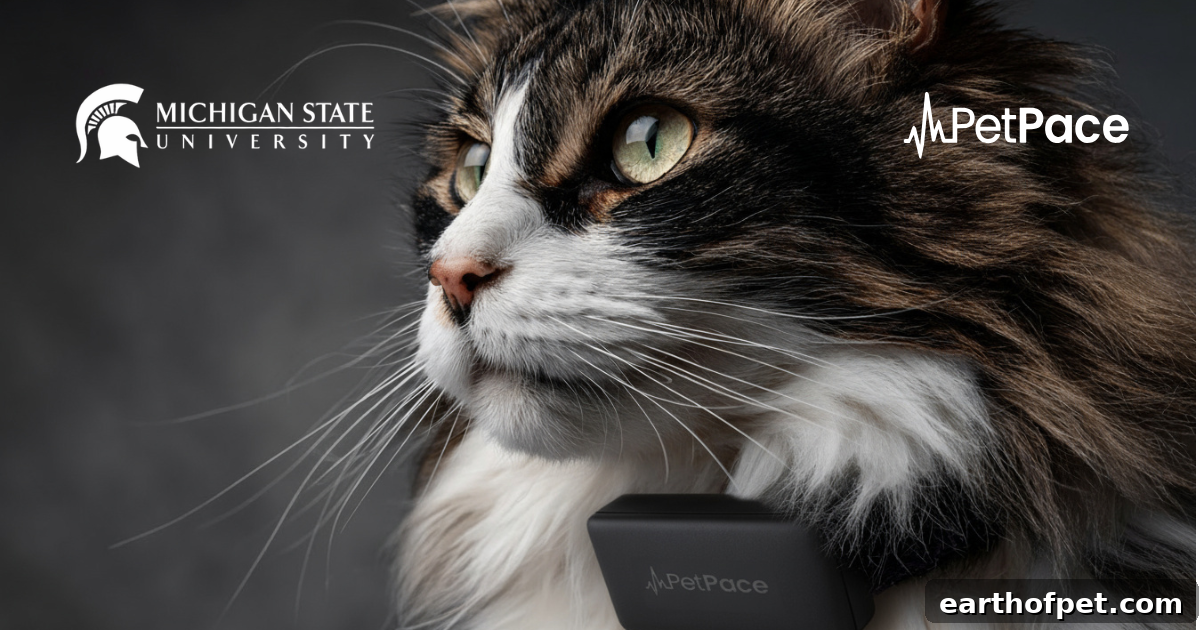
Central to the study’s data collection was the PetPace smart collar, a clinically validated device designed specifically for pets. The collar provided continuous, non-invasive monitoring of locomotor activity, movement intensity, and circadian patterns without disturbing the animals. Worn by cats as they entered the study, the collars recorded high-resolution, around-the-clock activity data that revealed consistent activity peaks at “lights on” across all lighting conditions and enabled precise detection of daily rhythms.
“The PetPace collar was an essential tool in our study,” said Dr. Alexandra Yaw, lead researcher. “Continuous, high-resolution data let us detect clear circadian patterns and correlate behavioral changes with physiological measures. Because the collars operate hands-off, our undergraduate researchers could collect reliable, 24/7 data with minimal disruption, producing insights that spot-check methods could not capture.”
The combination of continuous activity tracking, urinary cortisol assays, and behavioral observations allowed researchers to draw robust conclusions about how light quality influences both physiology and real-world behavior in a shelter setting. By pairing objective physiological data with validated stress scoring and movement patterns, the team could more confidently identify interventions that reduce stress in newly arrived shelter cats.
Unlike consumer wearables that focus mainly on GPS or basic fitness metrics, the PetPace collar is purpose-built for clinical-grade data collection. Its continuous monitoring and cloud-based analytics make it particularly suited for research, veterinary care, and animal welfare initiatives where precise, ethical monitoring in real-world environments is required.
Dr. Asaf Dagan, cofounder and Chief Veterinary Officer of PetPace, commented: “We’re pleased to see PetPace technology support high-impact, welfare-focused research. Objective, real-time insights into stress and behavior enable evidence-based improvements in shelter environments and veterinary practice.”
By enabling low-burden, ethical monitoring, the PetPace system helps shelters and researchers detect subtle changes earlier, supporting timely and welfare-centered decisions. This study reinforces the collar’s role as a practical tool for generating quantifiable evidence that can guide improvements in housing, husbandry, and lighting design for shelter cats.
For more information about PetPace and its research applications, visit the PetPace researchers page on the company website.