Patient Condition and History
Luka is a 6-year-old, 60 lb spayed female Golden Retriever who developed severe heat stroke after being left in a car for several hours on a hot summer day. Heat stroke, clinically referred to as hyperthermia, occurs when the body’s heat-producing and heat-dissipating mechanisms become overwhelmed, causing dangerously high core temperatures that can lead to organ dysfunction, collapse, and potentially death. Enclosed spaces such as parked vehicles dramatically reduce a dog’s ability to shed heat, making them a common setting for these life-threatening events.
In Luka’s case, she had wandered out of her fenced yard and was picked up by animal control. The officer kept her in a non-ventilated portion of the vehicle for nearly four hours. When she arrived at the shelter she was weak, barely responsive, unable to stand, and demonstrated labored breathing. Shelter staff placed Luka inside an air-conditioned car and transported her directly to a nearby veterinary emergency center for immediate care.
On presentation she was diagnosed with heat stroke complicated by vasodilatory shock. Additional problems identified included dehydration, metabolic acidosis, low potassium (hypokalemia), low phosphate (hypophosphatemia), and hematuria. Luka required intensive supportive care and was hospitalized in an ICU for two days. With prompt medical intervention and monitoring she gradually recovered and eventually made a full recovery.
Monitoring Data
At the time of the incident Luka was wearing a PetPace collar. The collar continuously recorded vital data and closely tracked the rise in her body temperature, detecting the hyperthermic episode in real time. The recorded temperature trace demonstrates a gradual climb into the danger zone followed by a rapid fall after cooling and medical treatment were initiated. These logged data played an important role in documenting the onset, severity, and resolution of Luka’s heat stroke.
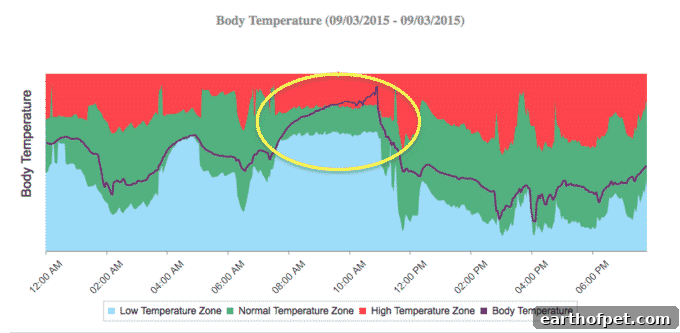
*LUKA’S DAILY TEMPERATURE GRAPH DURING HEAT STROKE. THE PURPLE LINE IN THE GREEN ZONE INDICATES NORMAL BODY TEMPERATURE, AND IN THE RED ZONE HYPERTHERMIA
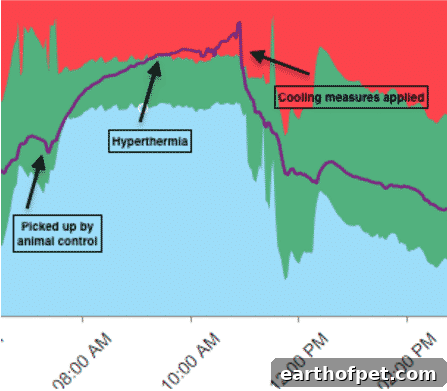
*CLOSE-UP VIEW OF THE TEMPERATURE GRAPH SHOWING HEAT STROKE EVENT. HYPERTHERMIA IS INDICATED BY THE PURPLE LINE CROSSING INTO THE RED ZONE.
Continuous remote monitoring devices like the PetPace collar can provide early and objective warning signs of rising body temperature and physiologic stress. In emergency situations, objective trend data help veterinarians assess the timing and severity of an event, guide treatment decisions, and document response to cooling and supportive care. In Luka’s case the collar’s temperature record captured both the progression into hyperthermia and the subsequent normalization that accompanied veterinary intervention.
Conclusions
Dr. Asaf Dagan, DVM, Diplomate ABVP (Canine and Feline practice) and PetPace’s Chief Veterinarian, observed that the PetPace collar can closely track and detect the development of heat stroke in real time using its thermoregulation assessment algorithm, a capability that may be life-saving when rapid recognition and response are required.
Dr. Zeev Gans, DVM, Diplomate ABVP (Canine and Feline practice), owner and medical director of Knowledge Farm Emergency Center in Israel, who treated Luka, emphasized that heat stroke remains a common and serious emergency in dogs. Early recognition, prompt cooling, and timely veterinary care are essential to improve outcomes. Automatic, continuous remote detection of rising body temperature and physiologic distress is a valuable addition to preventive pet care and emergency response.
Prevention is the most effective strategy to avoid heat-related illness. Owners should never leave dogs unattended in vehicles, even for short periods or with windows cracked, and should provide access to shade, fresh water, and cool environments during hot weather. Recognize warning signs—excessive panting, drooling, lethargy, wobbliness, vomiting, or collapse—and act quickly if they appear. If heat stroke is suspected, move the animal to a cooler area, begin gentle cooling (for example, wetting the coat with cool—not ice-cold—water), and seek immediate veterinary attention. Continuous monitoring tools and timely intervention together can reduce the risk of permanent injury and save lives.