Best Dog Food for Large Breed Puppies
If you’ve just welcomed a large-breed puppy into your home, get ready for an energetic, joyful journey. Puppyhood is a critical window for growth and development, and the right nutrition during this stage helps ensure your pup matures into a healthy adult. Choosing a diet formulated specifically for large-breed puppies gives them the best foundation for lifelong wellbeing.
What is considered a large-breed puppy?

Definitions vary slightly, but most veterinarians and pet nutritionists classify a dog as a large breed when its expected adult weight falls between about 55 and 100 pounds. Dogs expected to weigh more than 100 pounds at maturity are usually called giant breeds (examples include Great Danes and Newfoundlands). The Association of American Feed Control Officials (AAFCO) uses a slightly different threshold, defining a large-breed dog as any dog expected to weigh over 70 pounds once fully grown.
How does large-breed puppy food differ from regular puppy food?
Large-breed puppy formulas are designed to support a slower, more controlled growth rate compared with standard puppy foods. They typically contain fewer calories per cup and are balanced to promote steady development of bone, muscle and connective tissue over a longer growth period.
This is because larger breeds are not considered adult dogs until they are 18–24 months old, explains pet nutritionist Mark Finke, PhD.
Slower growth helps ensure bones, joints and soft tissues develop in proportion. Excess weight during growth places extra stress on developing joints and can increase the risk of orthopedic problems later in life. That’s why “puppy fat” can be misleading: a pudgy puppy may look cute, but extra body fat during development can be harmful—especially for large-breed dogs that are naturally more prone to joint concerns.
Recommended large-breed puppy diets
Puppies begin nibbling solid food around four weeks and are commonly weaned by about eight weeks of age. Once your puppy is fully weaned—around eight weeks—consider starting a high-quality, scientifically formulated large-breed puppy diet that meets AAFCO nutrient profiles for growth.
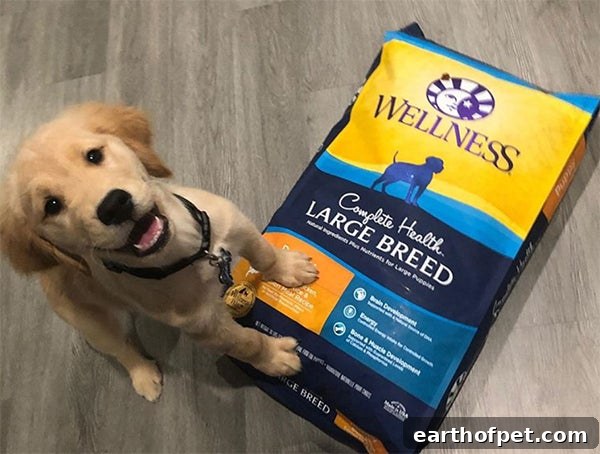
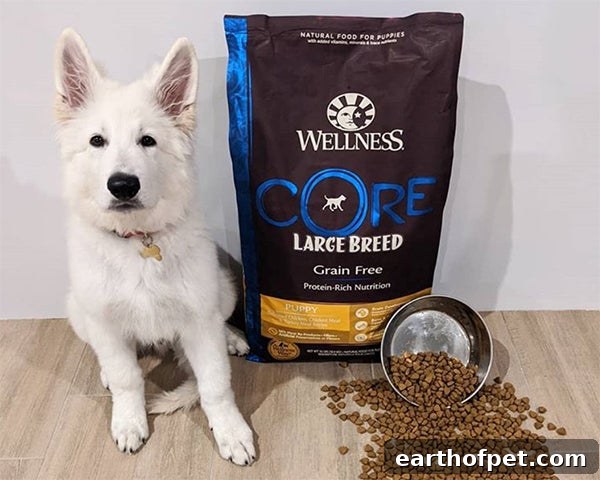
- Wellness CORE Large Breed Puppy (Deboned Chicken, Chicken and Turkey Meal) is one example of a diet formulated for large-breed growth. It includes DHA from salmon oil for brain development, controlled levels of calcium and phosphorus for healthy bone and muscle growth, and is fortified with vitamins and minerals to support a developing immune system.
- Wellness Complete Health Large Breed Puppy (Deboned Chicken, Brown Rice & Salmon Meal) is another recipe designed to support the nutrient needs of growing large-breed puppies.
These formulas consider the extended growth period of large breeds and aim to deliver balanced nutrition without the need for additional supplements. In fact, supplementing a puppy’s diet with extra calcium or minerals can be risky. Too much calcium may interfere with the absorption of other essential trace minerals such as copper and zinc, which are important for cartilage and bone development.
Feeding your large-breed puppy the right amounts
Free-feeding (leaving food available at all times) is not recommended for growing large-breed puppies. Instead, follow a scheduled feeding routine using the portion guidelines on the food packaging as a starting point. Those guidelines typically consider your puppy’s age and current weight to estimate daily portions. Reassess the portion size every few weeks and adjust as needed.
Use visual assessment and body condition scoring: if your puppy appears to be gaining too much weight, reduce the food amount by about 10 percent and monitor. Puppies vary, so frequent checks and adjustments help keep growth on track.
Young puppies have small stomachs and may benefit from more frequent, smaller meals. From about eight to 12 weeks you can divide the daily recommended amount into three or four meals. By 12 weeks, most puppies can be fed two to three times per day. Always measure food using a standard dry-cup measurement and level it off—improvised cups or heaping measures can add extra calories that lead to unwanted weight gain.
If you have specific nutrition questions, contact a trusted pet nutrition hotline or your veterinarian for tailored guidance. A qualified pet nutrition advisor can help you interpret feeding charts and select the right formula for your puppy’s individual needs.
When to switch to adult food
Because large breeds grow more slowly, they should remain on a puppy formula until at least 18 months of age. Giant breeds often benefit from staying on growth formulas until around two years old. When transitioning to adult food, make the change gradually over several days to a couple of weeks to avoid gastrointestinal upset: mix increasing amounts of the adult food with the puppy formula until the switch is complete.
Wet vs. dry food for large-breed puppies
Choosing between dry kibble, canned food, or a mix is a matter of preference and practicality. Keep in mind that puppies introduced exclusively to wet food can be harder to convert to dry later if you want to switch. Regardless of diet form, always provide plenty of fresh water.
When feeding multiple dogs or puppies, provide separate bowls spaced several feet apart and, if possible, out of direct line of sight of one another. This reduces food-guarding behavior and allows each animal to eat calmly and at their own pace.
Final thoughts
Selecting a large-breed puppy formula and feeding appropriate portions supports steady, balanced growth and helps protect long-term joint and skeletal health. With the right diet and portion control during the critical growth months, your large-breed puppy has the best chance to become a healthy, energetic adult ready for years of play and companionship.
Do you have a large-breed puppy? Share photos on social media using the handle @wellnesspetfood and the hashtag #wellnesspetfood for a chance to be featured.
*Survey of US Veterinarians, Data on File