People love to say you can't teach an old dog new tricks that old dogs can't learn. You've probably heard it: "You can't teach an old dog new tricks."
This is completely false.
Your seven-year-old dog, your twelve-year-old rescue, your senior dog with a grey muzzle — they can absolutely learn new behaviors. The science is clear: adult dogs learn just as well as puppies. The learning capacity doesn't diminish with age.
What does change is the approach. You're not adjusting because your dog's brain doesn't work — you're adjusting because your dog's body might have limitations and your dog has years of learning history that either helps or complicates new learning.
Why Older Dogs Learn Differently
Adult and senior dogs have several advantages over puppies:
Better impulse control — older dogs usually have better ability to focus and maintain attention than puppies.
More life experience — your older dog understands the basic concept of training. They know that human = structure and communication.
Larger bladder and bowel control — if you're potty training, older dogs can hold it longer than puppies.
Potentially less energy — some see this as a disadvantage, but it means shorter, more focused training sessions can be very effective.
The potential challenges:
Years of learned behaviors — if your dog has been doing something for seven years, changing that behavior takes patience. But it's not impossible.
Possible health issues — arthritis, cognitive dysfunction, or pain can affect training. You adjust for these limitations.
Possible past trauma — rescue dogs might have previous negative experiences with training. You move slower and with extra reassurance.
Slower physical response — an older dog might take longer to physically position themselves, so you need patience with the timing.
Health Considerations Before Training
Before starting training, especially if your dog is senior, consult your vet.
Ask about:
- Pain or arthritis that might make certain positions difficult
- Hearing or vision loss affecting how your dog receives commands
- Cognitive dysfunction that might affect learning
- Energy level and exercise tolerance
Adjust your training based on any limitations. If your dog has hip arthritis, maybe avoid extensive sit-stay practice. If they have hearing loss, add hand signals.
These adjustments don't mean you can't train — they mean you train smartly for your specific dog.
Training Approach for Older Dogs
The fundamentals are the same as puppies (positive reinforcement, consistency, patience), but the execution adjusts.
Shorter, More Frequent Sessions
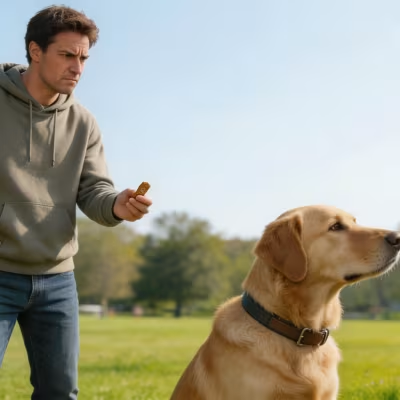
Older dogs have shorter attention spans than we sometimes think. Five-minute sessions are perfect. Multiple sessions per day is better than one long session.
Your dog still has neural plasticity at any age — the capacity to learn. But they tire mentally faster.
Higher-Value Rewards
Find what genuinely excites your older dog. Sometimes it's different from what excited them as a puppy. Some older dogs care less about food and more about praise or play.
Use the reward that actually motivates your individual dog.
Patience with Latency
Your older dog might take longer to execute a command. They heard you, they understood, they're just moving slower or thinking about it.
Don't repeat the command while waiting. Give them time to respond. That pause might be two seconds longer than a puppy would take. That's okay.
Gentle Progression
Older dogs might have physical limitations. Don't push jumps if they have hip issues. Don't require long downs if they have joint pain. Modify the exercise to what's physically comfortable.
Your dog can learn sit even if they can't do it perfectly. They can learn come even if they move slowly. Adjust expectations to their capabilities.
Specific Training for Older Dogs
Loose-Leash Walking
This is often easier to teach older dogs because they're naturally slower. Your pace and their pace are closer. Fewer distractions usually means better focus. Many older owners are amazed at how quickly their senior dog learns to walk nicely.
Basic Commands (Sit, Down, Stay)
These teach just as well for older dogs as puppies. The progression is identical — show the behavior, reward it, repeat. Your older dog will learn sit in 2-3 weeks just like a puppy.
Recall (Come)
Potentially harder if your dog has years of not-reliable recall. You're essentially retraining. But it's fixable with patience. Start in boring environments, build duration and distance slowly.
Problem Behavior Modification
Teaching an older dog to stop an existing problem behavior is possible but might take longer because the behavior is established. Use the same positive reinforcement approach: reward the alternative behavior heavily, prevent opportunities for the old behavior, be patient.
Case Study: The Rescue Dog
Many people adopt older rescue dogs and assume training isn't possible. Not true.
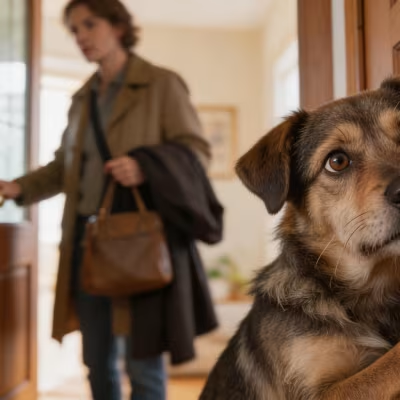
Rescue dogs sometimes come with problem behaviors, previous trauma, or lack of socialization. But they're absolutely trainable.
Approach with extra patience. Your rescue dog might have learned that training involves punishment or fear. Show them consistently that your training is different. Reward heavily. Move slowly. Build trust.
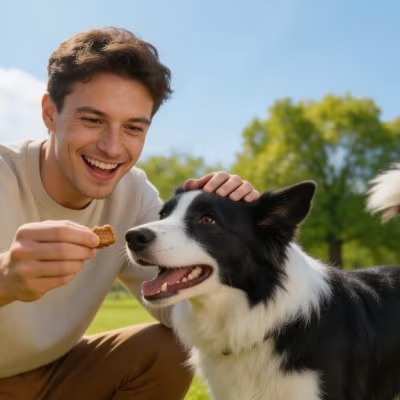
Most rescue dogs respond surprisingly well to positive training. They're often relieved to learn that cooperation is rewarding instead of scary.
Common Challenges and Solutions
Challenge: Your older dog seems stubborn and slow to learn. Solution: You might be moving too fast or the environment might be too distracting. Slow down. Try again in a quieter space.
Challenge: Your dog has physical pain that prevents certain positions. Solution: Consult your vet about pain management (medication, supplements). Modify exercises to what's physically comfortable.
Challenge: Your dog has learned the wrong behavior for years. Solution: Retraining takes longer, but it's possible. Prevent the old behavior (manage the environment), heavily reward the new behavior, be patient.
Challenge: Your dog seems disinterested in training. Solution: Find higher-value rewards. Sometimes older dogs aren't food-motivated. Try play, praise, or access to preferred activities.
Training Your Older Dog Has Extra Benefits
Training an older dog isn't just about teaching them new things. It provides mental stimulation, which is critical for brain health in senior dogs.
A dog whose brain is active and challenged stays sharper longer. Training, puzzle toys, new experiences, and learning all keep your dog's mind young.
You're not just training your older dog for behavior change. You're providing brain enrichment that supports overall health and quality of life.
Life Stage Adjustments
Adult dog (3-7 years): Full training capability. No major adjustments needed beyond normal training principles. These are often the easiest dogs to train because they have impulse control but aren't yet dealing with age-related issues.
Senior dog (7-10 years): Beginning to slow down physically. Maintain similar training approach but watch for fatigue. More frequent shorter sessions work better.
Geriatric dog (10+ years): Significantly slower, possibly some pain or cognitive changes. Even shorter sessions. Adjust exercises for any physical limitations. Focus on quality of life and mental stimulation.
FAQ: Training an Older Dog Answered
Q: At what age is a dog too old to train? A: There's no age limit. I've trained healthy dogs at 14 years old successfully.
Q: How long does it take to train an older dog? A: Similar timeline to puppies for basic behaviors. Usually 2-3 weeks for simple commands. Longer for behavior modification of established behaviors.
Q: My older dog has cognitive dysfunction. Can I still train? A: Cognitive dysfunction (canine dementia) affects learning, but you can still train simpler behaviors. Shorter sessions, higher-value rewards. Work with your vet on management too.
Q: Should I avoid training if my dog has arthritis? A: No. Avoid exercises that cause pain, but training itself (especially mental training) is beneficial. Consult your vet on which physical behaviors are comfortable.


0 Comments
No comments yet. Be the first to share your thoughts!
Leave a Comment