Flying with an emotional support animal used to be pretty straightforward. Your ESA had a letter from your therapist, and you walked onto the plane with your dog, cat, or occasionally more unusual companions. No pet fee. No carrier required. Just a seat next to you at no extra cost.
Then January 11, 2021 happened, and everything changed.
The U.S. Department of Transportation issued a final rule that reclassified emotional support animals as pets on commercial flights. If you've got an ESA and you're planning air travel, this is the single most important thing you need to understand: your emotional support animal is no longer flying free in the cabin with you. You'll now pay a pet fee, use a carrier, and follow the same rules as anyone flying with a regular pet.
I know this is frustrating if you've been flying with your ESA for years under the old system. But I'm going to walk you through what actually changed, how different airlines handle it now, and exactly what you need to do to fly with your animal in 2026.
What the DOT Rule Change Actually Means
Before January 2021, the Air Carrier Access Act allowed people with disabilities to bring emotional support animals (ESAs) into the cabin without charging a pet fee. All you needed was a letter from a licensed mental health professional saying the animal was necessary for your disability. The airline had limited ability to deny the animal or charge you.
This system got abused—badly. People were bringing all kinds of animals on flights, sometimes claiming ESA status when they just wanted their pet with them. There were emotional support peacocks, rabbits, ferrets, and a lot of dogs that weren't actually trained for anything except looking cute.
The DOT got fed up and issued new rules. Here's what changed:
ESAs are now classified as pets, not service animals. This is the crucial distinction. Emotional support animals receive no special accommodations on planes anymore. You'll pay a pet fee just like someone traveling with a family dog.
The letter from your therapist doesn't matter for airline purposes. Your ESA letter might still be useful for housing (under the Fair Housing Act) or other situations, but airlines don't care about it anymore. They treat your ESA as a regular pet.
Only psychiatric service dogs get special treatment. And it's very specific. We'll get into this, but the bar is high.
Airline-by-Airline Pet Policies (2026)
Let me break down the big carriers and their actual pet policies right now. These change occasionally, so definitely verify on the airline's website before booking, but here's what's current:
Delta Air Lines
Delta allows one pet in the cabin for a $150 fee (one way). The pet must fit in a carrier that's 18 inches long, 14 inches wide, and 8 inches high. That's small—like a medium-sized dog or cat, or a couple of rabbits.
For cargo hold, they accept pets for $200 one way. Checked pet in-cabin is an additional $150 on top of your luggage fees.
Delta's policy is pretty clear: no animals outside carriers, no emotional support letters, just pets as pets. They'll ask to see your pet before boarding to verify it fits the carrier.
What you need to know: if your pet is larger than the carrier specs, Delta won't let it on. They're serious about this. And if you're flying with a dog that's 30+ pounds, you're probably out of luck with Delta unless you use their cargo option (which costs more but allows larger animals).
United Airlines
United charges $125 per pet in the cabin, one way. The carrier limit is 17.5 inches x 9.5 inches x 8 inches—slightly smaller than Delta's allowance.
United also has a "PetSafe" program for cargo, which costs $200-$300 depending on the route and pet size. They're generally considered more pet-friendly than some carriers, and they have more experience handling animals.
One thing to know: United won't fly brachycephalic (flat-faced) dogs and cats on cargo flights due to breathing issues. Persians, Bulldogs, Pugs—these breeds have limitations.
United's customer service for pet travel is generally solid. If you call ahead and explain your situation, they're usually willing to work with you. They also have pet relief areas at major hubs, which is helpful for longer layovers.
American Airlines
American charges $150 per pet in the cabin, one way. Their carrier dimensions are 19 inches x 14 inches x 9 inches—the most generous of the major carriers.
American also allows pets on select international flights, which is helpful if you're traveling internationally with your ESA. They have country-specific rules, which we'll cover later.
One advantage with American: they have a pet program called "Pet First" where you can pre-register your pet and get tips about flying with them. You can also schedule your pet a "pet relief spot" on long layovers, which is genuinely helpful.
Southwest Airlines
Southwest is actually the most pet-friendly major carrier. They charge $95 per pet in the cabin, one way. It's the cheapest option out there.
The carrier must fit under the seat in front of you and be no more than 10 inches tall. That's tight for large animals, but it's still the best rate if you've got a small pet.
Southwest doesn't fly pets in cargo/checked baggage, so if your animal doesn't fit the carry-on rules, you're stuck.
The downside: Southwest boards in zones rather than by seat location, so you don't have reserved seating. This can make it harder to coordinate with your pet. But if you book early and get an early boarding position, it's less stressful.
JetBlue Airways
JetBlue charges $125 per pet in the cabin, and the carrier needs to fit under the seat in front of you. Their specific dimension limit is 17 inches x 12.5 inches x 8.5 inches.
JetBlue is pretty flexible about animal types—they accept cats, dogs, rabbits, guinea pigs, and other small domestic animals. They're stricter about exotic animals than some carriers.
JetBlue also has decent customer service and they're generally accommodating about pet travel. Their planes have better air circulation than some carriers, which is a small bonus for your animal's comfort.
Alaska Airlines
Alaska charges $100 per pet in the cabin, one way. Their carrier limit is 17.5 inches long x 8.5 inches wide x 7.5 inches tall.
Alaska also flies pets on cargo for $200-$500 depending on the route and pet weight.
Alaska's a solid option if you're on the West Coast. They have a good reputation for pet handling and they're generally less crowded than the major East Coast carriers.
The Psychiatric Service Dog Loophole (And It's a Real One)
Here's where it gets interesting. While emotional support animals got reclassified as pets, psychiatric service dogs (PSDs) retained their special status.
But—and this is important—the standards for what qualifies as a psychiatric service dog are strict, and the DOT actually left the definition pretty vague. Most airlines follow the ADA definition, which says a service dog is "individually trained to do work or perform tasks for a person with a disability."
The task has to be job-specific. For psychiatric service dogs, that might mean:
- Deep pressure therapy (literally lying on someone during a panic attack to provide grounding)
- Blocking/spacing (creating a physical barrier between the handler and strangers)
- Interrupting harmful behaviors (like stopping someone from engaging in self-harm)
- Retrieving medication or emergency alerts
- Recognizing symptoms of an oncoming crisis before the person does
- Interrupting dissociative episodes
- Fetching emergency contacts during panic attacks
Your ESA's job, by comparison, is just existing and providing comfort through its presence. That doesn't qualify.
Airlines will ask. They might ask if your dog is a trained service dog. They might ask what specific tasks the dog performs. You need to have an honest answer, because lying about this violates federal law. Your dog might be a wonderful emotional support, but if it's not actually trained for a specific task, it doesn't qualify as a psychiatric service dog.
The honest truth: most ESAs don't meet the psychiatric service dog standard. That doesn't mean your animal isn't valuable to you—it means it gets treated as a pet on planes.
How to Actually Fly with Your ESA Right Now
Okay, so your emotional support cat or dog isn't getting free cabin access anymore. Here's the step-by-step for flying with your ESA in 2026:
1. Choose your airline based on pet fees and carrier limits. If your animal is medium-to-large, American Airlines offers the biggest carrier space. If cost is your priority, Southwest is cheapest at $95. If you're on the West Coast, Alaska is solid. Compare based on your specific situation.
2. Book early and specify that you're traveling with a pet. This matters. Airlines have limited pet capacity—they usually allow 5-10 pets per flight to prevent the cabin from becoming a zoo. Book your pet at the same time you book yourself. Call the airline directly if you need to ensure the booking is recorded.
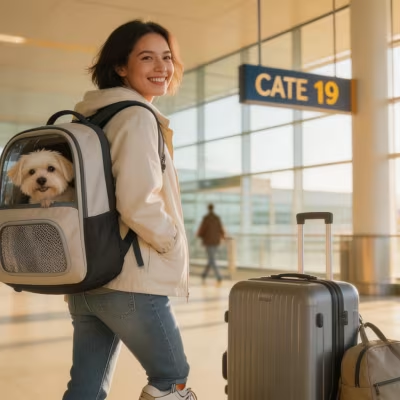
3. Get a pet-appropriate airline carrier. The carrier needs to fit the airline's dimensions and be well-ventilated. Your animal should be able to stand, turn around, and lie down inside. For a medium dog, you're looking at something like the Petmate Sky Kennel (which costs $80-$150 depending on size). For cats, the Petmate or Ferplast carriers work well. Make sure it's airline-approved—some soft-sided carriers aren't acceptable.
4. Take your animal to the vet before flying. Get a health certificate if you're flying internationally. Make sure your animal is up-to-date on vaccines, especially for international travel. Your vet can also give you advice about calming medications if your animal is anxious.
5. Pay the pet fee. Budget $95-$150 per leg of your journey. If you're flying round-trip with a connection, that could be $190-$300 total for your pet. That's a major expense that a lot of people don't anticipate.
6. Arrive early and have your vaccination records ready. Some airlines ask to see proof of current rabies vaccine. A simple vet visit summary works. Don't risk it—bring documentation.
7. Keep your animal calm during the flight. We'll talk about this more below. But the basic idea is: prepared animal, potentially medication, familiar comfort items.
The hardest part for most people isn't the logistics—it's the emotional shift. You're not getting the accessibility accommodation you used to, and that's a real loss. But I also want to be real with you: if your ESA isn't actually trained for a specific psychiatric task, this rule change was necessary. The old system had collapsed under the weight of people abusing it.
International Flying with Your ESA
International travel gets more complicated because different countries have different import regulations for animals.
USDA Health Certificate
If you're flying internationally, you need a USDA health certificate from a USDA-accredited veterinarian. This isn't just a regular vet visit. Your vet needs to specifically fill out the USDA form and certify that your animal is healthy and doesn't have any communicable diseases.
The timing matters: most countries require the health certificate to be issued within 10 days of travel. Some require it within 30 days. Plan ahead. Get the certificate at least 4 weeks before travel if possible, so you have time to handle any issues.
Cost is usually $50-$150 depending on your vet and the animal. Some vets charge extra for USDA forms.
Microchipping and Rabies
Virtually every country that accepts pets requires either a microchip or a tattoo for identification, plus a current rabies vaccine. The microchip is easier—it's a quick procedure and costs $25-$50. It lasts your animal's whole life.
The rabies vaccine needs to be current, and most countries require it to be administered at least 30 days before travel (but not more than 12 months before). Get your animal microchipped and vaccinated at least 6 weeks before international travel.
Quarantine Requirements
This is where it gets nasty. Some countries require quarantine periods—sometimes weeks or even months—when animals enter.
Australia is the worst offender. They require 10 days to 30 days of quarantine depending on your origin country. There's also an Import Permit you need to get in advance, which can take weeks. Australia's quarantine is strict because they want to prevent disease introduction. If you're moving to Australia with your ESA, plan for at least a month of quarantine and $2000+ in associated costs.
The UK has relaxed rules for pets coming from the US (it's basically just the health certificate, microchip, and rabies vaccine now), but it changes regularly. As of 2026, US animals can enter the UK pretty easily if you have the right paperwork. But check before you travel because rules change.
Japan requires quarantine periods and extensive paperwork. Most of Europe is more reasonable—usually just health certificates and vaccinations.
Check the destination country's agriculture/animal import website before booking your flight. This is critical. Some countries won't accept certain breeds or animals at all. For example, some countries don't allow rabbits to be imported as pets. Some countries have restrictions on pit bulls or aggressive dog breeds. Know the rules before you book.
Emotional Preparation: Flying with Your ESA
Your emotional support animal is probably used to being with you all day. Flying is stressful for animals—weird noises, pressure changes, unfamiliar environments, confined spaces.
Start with short practice flights if possible. Get your animal used to the carrier and the airport environment. Some airports have pet relief areas where you can practice. Drive to the airport, hang out in the pet relief area, get back in the car. Repeat a few times so the experience is less shocking when it's real.
Use calming supplements before flying. Talk to your vet about options. L-theanine, L-tryptophan supplements, or prescription anti-anxiety medication (like trazodone) can help without sedating your animal too much. Airlines have gotten more careful about overly sedated animals because it can affect their breathing during flight. Your vet can recommend the right dose.
Exercise your animal heavily the day before. A tired pet is a calmer pet. Take your dog for a long run or your cat through a play session. They'll sleep through the flight more easily. A 30-minute walk might not be enough—aim for 45-60 minutes of solid exercise.
Bring familiar items. A blanket that smells like home, your scent on a shirt, a favorite toy—these comfort objects matter. Put them in the carrier so your animal has some familiarity.
Keep a short leash on your dog when you're out of the cabin (during boarding, deplaning). Even a sweet ESA dog might panic and bolt in an airport. Control the situation. Airports are chaotic and a stressed animal can slip away from you.
For cats in carriers: cover the carrier partially with a blanket to create a den-like feeling. Cats feel safer when they're somewhat enclosed. Leave enough gaps for air circulation though.
Visit the pet relief area before boarding. Most airports have designated areas where you can let your dog out to pee and poop. Use them. You don't want your animal holding it for 8+ hours. Get there early enough that you're not rushed.
Have your vet's contact info and a vet in your destination city. If your animal gets sick during travel, you need to know who to call. Look up emergency vet clinics in your destination before you leave.
Never sedate your animal without vet approval. Some people think sedation is the answer, but over-sedation can be dangerous during flight. Talk to your vet about appropriate calming options.
FAQ: Your Real Questions About Flying with ESAs
Q: Can I fly with my ESA without paying the pet fee?
No. Not since 2021. The DOT ruling was final. Even if you have a letter from your therapist, airlines won't accept it as an exemption anymore. There's no legal workaround here. I understand this is frustrating, but the rule is absolute.
Q: What if my ESA won't fit in the carrier?
Then you have a few options: fly with a different airline that has larger carrier dimensions, explore cargo/checked baggage options (though these are limited and more expensive), or find alternative travel methods. A dog weighing 100+ pounds probably isn't airline-friendly anymore if they're classified as an ESA. Some people use services like "door-to-door" pet transport companies that drive animals to destinations instead of flying them.
Q: Can I leave the carrier open during the flight?
No. Federal aviation regulations require that animals be in carriers during flight. The carrier has to be under the seat in front of you or in an approved overhead space (which is rare). Your animal can't roam the cabin. This is a safety regulation, not an airline choice.
Q: What happens if my ESA has a meltdown on the plane?
If your animal becomes aggressive or disruptive, the flight crew has the right to move your animal to cargo, turn the plane around, or even refuse to fly with you. This is rare, but it happens. This is why preparation and sometimes medication matter. If your animal is prone to anxiety or aggression, talk to your vet seriously about whether flying is safe for them.
Q: Do I need travel insurance for my ESA?
It's not required, but it's worth considering if you're flying internationally or if your animal has health issues. Some pet travel insurance covers unexpected vet costs and emergency transportation. It's usually $100-$300 per year depending on coverage. For a one-time international trip, it might not be worth it, but if you're flying frequently with your animal, it makes sense.
Q: Can my ESA sit on my lap during the flight?
During takeoff and landing, no. During normal flight time, it depends on the airline's policy and whether the animal fits in its carrier. Most carriers have the animal stay in the carrier the entire time. Some airlines might let you take an animal out briefly during cruise altitude if it's sitting under the seat, but don't count on it. The safe assumption is: carrier stays on, animal stays in.
Q: Is there any way to get my ESA exempted from the pet fee?
Only if your animal is a fully trained psychiatric service dog that performs specific trained tasks related to your disability. And that has to be an ADA-recognized service dog, not just an ESA with a letter. The bar is genuinely high. If you think your dog might qualify, talk to a disability advocate or lawyer, not an online forum.
Q: What about emotional support on trains or buses?
Amtrak and Greyhound still allow ESAs in the cabin, though they may require crates depending on the specific route. Amtrak's policy is more flexible than airlines. But you should call ahead and confirm. These companies sometimes update their rules too. Amtrak allows ESAs in sleeping cars and regular coach with documentation, but requirements vary by route.
Q: My ESA helps me with anxiety. Isn't that a service dog task?
The DOT's position is that comforting presence alone doesn't count. Your ESA's job of being calm and present is valuable, but the ADA service dog definition requires the dog to be individually trained to do a specific work or perform a specific task. Anxiety relief through presence isn't specific enough. The dog would need to do something active—recognize anxiety symptoms before you do, perform pressure therapy, retrieve meds, interrupt dissociative episodes, etc.
Q: Can I fly internationally with my ESA to countries that don't recognize the DOT rule?
Different countries have different rules about animals on planes. Some European carriers are more lenient with ESAs. But you still need the USDA health certificate and country-specific import approval. And most modern airlines in developed countries follow similar restrictions to US carriers anyway. Call the specific airline ahead of time if you're flying internationally with an ESA.
Q: What if the airline denies my pet at the gate?
Unfortunately, this happens sometimes. Carriers that are slightly oversized, animals that seem unwell, or situations where the flight is fully booked on pets—all these can result in denial at the gate. If this happens, you'll be denied boarding and you'll lose your ticket. The airline might rebook you on a later flight at no charge, but you might also lose money. This is why checking dimensions and calling ahead matters. And why pet travel insurance exists.
The Bottom Line
Flying with an emotional support animal in 2026 is a different experience than it was five years ago. You're paying a pet fee. Your animal is in a carrier. You follow the same rules as someone flying with a dog they got from a shelter.
This sucks if you've been flying for free with your ESA for years. I get it. But here's the thing: the old system was broken. People were gaming it. That made it harder for people with actual psychiatric service dogs and people with genuine disabilities. The new system is more equitable, even if it's less convenient for you.
What hasn't changed: your animal still provides you comfort. Flying with your ESA is still possible. You just have to plan better and pay for the privilege.
Budget your pet fees. Book early. Get the right carrier. Prepare your animal. And remember—you've got this. Thousands of people fly with their ESAs every week. It's complicated now, but it's doable. Your animal depends on you to make this work, and with proper planning, you absolutely can.




0 Comments
No comments yet. Be the first to share your thoughts!
Leave a Comment